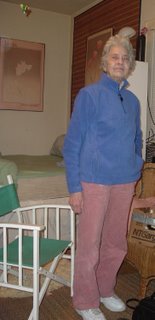
On the evening of Super Tuesday the spring peepers burst
into sound. Accounts I've read elsewhere state that the
peepers can be heard as early as mid-March, and are a
sign that spring is on the way.
Mid-March indeed. Those were northern writers
accustomed to colder climes. The peeping has
always started here in Northwest Georgia in
February, but even so, the 8th, the Big Tuesday,
was a little early for them.
It had been an unusually warm day, which probably
helped to bring them out, just as it had helped the voter
turn-out, even in the states further north, according to
news accounts. After dark it was much cooler, but yet
not really cold. Clouds covered the moon and hid the
stars, and I knew that the balmy day, rather than
beginning spring, simply presaged the coming rain,
whose heirs, in turn, would be more freezing nights
and mornings.
I was still wearing my "I'm a Georgia voter" sticker
when I slipped into my old coat, strapped on my
headlight, and headed off to the woods across the
road. Buckie trotted ahead of me, stopping to sniff
here and there, but still managing to navigate the thorny
underbrush and pine thickets better than ever I can.
As it seems that the frogs have always been singing on
a day before it rained, I used to think they were singing
for the rain, sort of a vocal rain-dance ceremony.
Now I know their shrill, ear-splitting chorus is only
the background for their annual orgy. Other creatures
engage in group sex, but no others mate amidst such
loud and jubilant rejoicing.What a great way to celebrate
being alive and aware again after the death-like sleep of
hibernation. One account I read stated that most of the
frog's body can be frozen while hibernating and not prevent
its full recovery.
The peepers do not choose the creek, but favor the spill-
over from a spring in the midst of the woods. There was
once a farmhouse, and perhaps some sort of spring house
where the farmer's wife set butter and milk to cool in warm
weather. Both are long gone, but the barn still stands, lights
from cars along the road glinting on its tin roof.
There are deep ruts from the heavy equipment used by
Georgia Power to clear beneath the power lines, and along
these ruts, eroded into ditches, flow small tributaries toward
the creek.
Following the ruts, one skirts a sort of marsh land, then the
small pools here and there, before reaching the larger body of
water that is the spring. As I draw closer, the sound becomes
deafening. What was a pleasant evening sound as I was
leaving my yard becomes cacophony close at hand.
You would think such noise would mask the sound of my
careful footsteps, already muffled by the thick carpet of
wet leaves. Yet, when I get too close to one of the pools
or ditches the sound stops. Or most of it. There are always
two or three laggards peeping on for a second or two, then
cutting off in mid-note, as if suddenly aware of the
strangeness of solo singing.
The coordination of the frog singers seems remarkable:
together they sing from pools scattered across a large
area, together they stop and sit in dead silence, no sound
but the distant rippling of the creek.
No matter how stealthy my approach, I cannot see any
of the tiny frogs at night. The largest would be only about
one-and-a-half inches long, some are under the debris at
the bottoms of the pools laying eggs, others scattered
about the banks, their color blending with the dead leaves
under which they hide.
Not until Buckie and I are back in our yard are they again
giving full voice to the same urgent jubilation. They will sing
like this for about a week, mostly in the evenings, providing
a pleasant background to our lives beside the creek.
Almost two weeks after our walk in the woods, on the
day after the next round in the primary voting contest
this time, I heard spring peepers at the pond in my
neighbor's pasture. Those at the spring were quiet,
they've gone back into the woods, perhaps becoming
inanimate again during the cold nights.
There were far fewer at the pond, no deafening wave of
sound, it was more as if they were singing rounds than
creating a chorus. That they were there at all intrigues me.
The spring peeper is a tree frog. Although, according
to some naturalists, the tiny frogs spend as much time
on the ground as in the trees, their natural habitat is
the woods. They do not live in pastures. To get to the
pond from the closest woods they would have to cross
the creek and a wide stretch of grass, constantly in
danger of being eaten by crows before dark and by owls
at night, then again when they retrace their steps-
or hops- back to the woods, where they will live in
relative silence and obscurity for the rest of the year.
I suppose that just as the birds return to the area where
they once were nestlings to build their own nests, the
frogs spawned and metmorphosed from tadpoles in the
pond remember to return there, and so they do, every
February.
There are even fewer there this evening, no chorus, no
rounds, just solos and an occasional quartet. In another
month it will be spring by the calendar, but I am weary
of cold weather and bare trees and the peepers have
provided a welcome respite.
Pictures and a sound clip of their cries is available on
the National Geographic website.
And by the way, about that Super Tuesday: Hilary Clinton
won my precinct. But Obama won the state, my vote counted.
Sunday, February 24, 2008


Saturday, February 16, 2008
Washington's Birthday
One February many years ago, Andy, my youngest child,
walked with me to our rural mailbox. The box was empty.
Oh," I said, "I forgot. There'll be no mail today. It's
Washington's Birthday."
Andy's eyes widened. "If he has a party, can we go?"
"Andy," I said, "Washington is dead. He's been dead for
a long, long time."
"Well why does he keep on having birthdays then!"
Andy started back to the house, disappointed.
Well, he doesn't anymore. Doesn't have his own day in
red on the calendar. Now it's Presidents Day. But there
will be no mail, a sort of holiday for me. I won't have to
get to the post office with my book orders packaged and
ready to mail.
Andy will be working as usual. Just another Monday for
him.
walked with me to our rural mailbox. The box was empty.
Oh," I said, "I forgot. There'll be no mail today. It's
Washington's Birthday."
Andy's eyes widened. "If he has a party, can we go?"
"Andy," I said, "Washington is dead. He's been dead for
a long, long time."
"Well why does he keep on having birthdays then!"
Andy started back to the house, disappointed.
Well, he doesn't anymore. Doesn't have his own day in
red on the calendar. Now it's Presidents Day. But there
will be no mail, a sort of holiday for me. I won't have to
get to the post office with my book orders packaged and
ready to mail.
Andy will be working as usual. Just another Monday for
him.
Wednesday, February 13, 2008
Purveyors of Violence
Hey, Kids! What time is it?
Never mind. This is much too serious for that. The State of
the Union. President George W. Bush stating to us that the
union might be moribund, but he, George, is going to revive
it with a shot in the arm.
Shoveling money into the pockets of the wealthy didn't do
the job. Didn't trickle down, just a painfully slow ooze. Now
he's going to try the other arm. Trying to stave off the
Recession that's coming at us like a yapping dog about to bite.
A week before his speech, while he was performing a knee-
jerk tribute to Dr. King, he studiously avoided any mention of
war. He and Hilary. Both praised Dr.Martin Luther King, Jr.,
for his courage, for his leadership in the Civil Rights
Movement.
They wouldn't have mentioned his courageous stand against
the Vietnam War, the speech in which he branded the U.S.
Government as "the greatest purveyor of violence in the
world today", for if "Iraq" were substituted for "Vietnam",
the speech would indict Bush, Hilary Clinton, and all those
who instigated and voted for the war in Iraq.
Never mind. This is much too serious for that. The State of
the Union. President George W. Bush stating to us that the
union might be moribund, but he, George, is going to revive
it with a shot in the arm.
Shoveling money into the pockets of the wealthy didn't do
the job. Didn't trickle down, just a painfully slow ooze. Now
he's going to try the other arm. Trying to stave off the
Recession that's coming at us like a yapping dog about to bite.
A week before his speech, while he was performing a knee-
jerk tribute to Dr. King, he studiously avoided any mention of
war. He and Hilary. Both praised Dr.Martin Luther King, Jr.,
for his courage, for his leadership in the Civil Rights
Movement.
They wouldn't have mentioned his courageous stand against
the Vietnam War, the speech in which he branded the U.S.
Government as "the greatest purveyor of violence in the
world today", for if "Iraq" were substituted for "Vietnam",
the speech would indict Bush, Hilary Clinton, and all those
who instigated and voted for the war in Iraq.
Wednesday, January 16, 2008
Selma, Lord, Selma
Shyann Webb was 8 and small for her age, Rachel West
was 9. Two little girls caught up in the marches, mass
meetings, police violence, of the 1965 campaign for
voting rights in Selma, Alabama, where less than 2% of
eligible African Americans were registered to vote.
They tell about it in the book:
Selma, Lord, Selma
by Shyann Webb and Rachel West Nelson
as told to Frank Sikora
1980 University of Alabama Press
There are photos showing these smallest marchers with
Dr. Martin Luther King, who, whenever he saw them
would call out, "What do we want?" and when they
would answer: "Freedom!" would say, "I can't hear
you," and make them say it louder and louder,
"Freedom! Freedom!"
And a photo of the two on a cold day when the
marchers had been halted, Shyann in a dress, her
little legs bare, Rachel's hand-me-down pants too
small, stopping inches above her socks. They
lived near one another in a housing project, their
large families, they said, lived mostly on rice and
coffee. But they marched, and they sang the freedom
songs. Dr. King called them to the front of the church
to lead the singing.
Shyann was at the meetings at Brown Chapel almost
every day, missing so much school she'd have to repeat
the grade the next year. She heard about the arrests, the
clubbings by policemen and sheriff's deputies, and the
death of Jimmie Lee Jackson, shot by a state trooper
in nearby Marion. That march and Jackson's death were
not covered by the media.
About three weeks later the Rev. James Reeb died from
injuries suffered when attacked by three white hoodlums.
Reeb was among the hundreds who poured into Selma
in response to "Bloody Sunday" when the marchers
were brutally attacked on the Edmund Pettus Bridge.
They had planned to march to Montgomery, the state
capital, to protest Jackson's death.
And there were other martyrs: Viola Liuzzo was shot
and killed in her car, on her way to transport marchers
from Montgomery. Jonathan Daniels, an Episcopalian
Seminary student, one of several supporters who stayed
with Rachel's family during the Selma protests, would be
shot by a sheriff's deputy just after being released from
jail in Lowndes County on August 20th.
The little girls talked about how they might also be killed.
Rachel was on the bridge on "Bloody Sunday" and only
escaped because another marcher picked her up and ran
with her to safety.
One night they looked up at the sky, searching for the
brightest star because they had heard that when
someone dies their soul becomes a star in the heavens.
One of them pointed out an especially bright star and
said that maybe that one was Jimmie Lee Jackson.
Reeb's death was the catalyst that spurred President
Johnson and Congress to push through the Voting Rights
Act. Johnson telephoned his sympathy to Reeb's family,
and he personally announced the arrest of the Klansmen
who shot Liuzzo.There was no sympathy call to Jackson's
family, no attempt to indict the trooper who shot him.
Liuzzo and Reeb were white, Jackson was Black.
Two little Black girls were right to believe that death could
come to them from a policeman's gun or club in the midst
of their songs about Freedom.
was 9. Two little girls caught up in the marches, mass
meetings, police violence, of the 1965 campaign for
voting rights in Selma, Alabama, where less than 2% of
eligible African Americans were registered to vote.
They tell about it in the book:
Selma, Lord, Selma
by Shyann Webb and Rachel West Nelson
as told to Frank Sikora
1980 University of Alabama Press
There are photos showing these smallest marchers with
Dr. Martin Luther King, who, whenever he saw them
would call out, "What do we want?" and when they
would answer: "Freedom!" would say, "I can't hear
you," and make them say it louder and louder,
"Freedom! Freedom!"
And a photo of the two on a cold day when the
marchers had been halted, Shyann in a dress, her
little legs bare, Rachel's hand-me-down pants too
small, stopping inches above her socks. They
lived near one another in a housing project, their
large families, they said, lived mostly on rice and
coffee. But they marched, and they sang the freedom
songs. Dr. King called them to the front of the church
to lead the singing.
Shyann was at the meetings at Brown Chapel almost
every day, missing so much school she'd have to repeat
the grade the next year. She heard about the arrests, the
clubbings by policemen and sheriff's deputies, and the
death of Jimmie Lee Jackson, shot by a state trooper
in nearby Marion. That march and Jackson's death were
not covered by the media.
About three weeks later the Rev. James Reeb died from
injuries suffered when attacked by three white hoodlums.
Reeb was among the hundreds who poured into Selma
in response to "Bloody Sunday" when the marchers
were brutally attacked on the Edmund Pettus Bridge.
They had planned to march to Montgomery, the state
capital, to protest Jackson's death.
And there were other martyrs: Viola Liuzzo was shot
and killed in her car, on her way to transport marchers
from Montgomery. Jonathan Daniels, an Episcopalian
Seminary student, one of several supporters who stayed
with Rachel's family during the Selma protests, would be
shot by a sheriff's deputy just after being released from
jail in Lowndes County on August 20th.
The little girls talked about how they might also be killed.
Rachel was on the bridge on "Bloody Sunday" and only
escaped because another marcher picked her up and ran
with her to safety.
One night they looked up at the sky, searching for the
brightest star because they had heard that when
someone dies their soul becomes a star in the heavens.
One of them pointed out an especially bright star and
said that maybe that one was Jimmie Lee Jackson.
Reeb's death was the catalyst that spurred President
Johnson and Congress to push through the Voting Rights
Act. Johnson telephoned his sympathy to Reeb's family,
and he personally announced the arrest of the Klansmen
who shot Liuzzo.There was no sympathy call to Jackson's
family, no attempt to indict the trooper who shot him.
Liuzzo and Reeb were white, Jackson was Black.
Two little Black girls were right to believe that death could
come to them from a policeman's gun or club in the midst
of their songs about Freedom.
Monday, December 24, 2007
Welcome Winter Solstice
December 22. I look forward to this day every time I come
home from work in the dark at 6 p.m.
From this day forward there will be just a bit more daylight..
Forget about the 25th. Had the old solstice celebrations,
with pigging out and dancing around decorated trees, been
allowed to continue, I would heartily join in. But the church,
unable to wrest this holiday from the people, moved the date
of Jesus's birth, and so we have the hybrid with Santa and
his reindeer and sleigh hovering over the manger. Let us
keep the Holy midnight watch with hymns and chanting
and prayer, then rush over to the 24-hour Walmart to
max out our plastic.
And forget about Daylight Shifting Time. Or savings. If it's
being saved, I'd like to know where so I could withdraw
a few hours.
Supposed to be a mild winter this year. Lowest temperature
so far has been 22. The greens I planted haven't grown very
big, but continue to survive and have provided me with
several meals so far. The seeds cost $3, the cost of the labor
carrying water from the creek to keep them alive not
recorded. But they taste better, and I believe they are more
nutritious, than those available in the grocery stores. With
the prices of food skyrocketing, gardening can become an
economic necessity. Shall we all have victory gardens, as in
victory over hunger?
By prepaying my winter's supply, propane has cost me the
same per gallon as last year, but I have read there will be a
steep price increase next year. I think about using some
electrical heat, but I'm afraid the cost of electricity will also
escalate.
Shorter days and shrinking dollars.
And economists say the housing foreclosure crisis
reverberates, causing a credit card crunch, more defaults and
a higher rate of overdue payments.
But the rich continue to receive tax relief and the Department
of Defense recently signed a contract potentially worth
750 million for an Atlanta advertising agency to create ads
that will entice young men into joining the U.S. Marine Corps.
home from work in the dark at 6 p.m.
From this day forward there will be just a bit more daylight..
Forget about the 25th. Had the old solstice celebrations,
with pigging out and dancing around decorated trees, been
allowed to continue, I would heartily join in. But the church,
unable to wrest this holiday from the people, moved the date
of Jesus's birth, and so we have the hybrid with Santa and
his reindeer and sleigh hovering over the manger. Let us
keep the Holy midnight watch with hymns and chanting
and prayer, then rush over to the 24-hour Walmart to
max out our plastic.
And forget about Daylight Shifting Time. Or savings. If it's
being saved, I'd like to know where so I could withdraw
a few hours.
Supposed to be a mild winter this year. Lowest temperature
so far has been 22. The greens I planted haven't grown very
big, but continue to survive and have provided me with
several meals so far. The seeds cost $3, the cost of the labor
carrying water from the creek to keep them alive not
recorded. But they taste better, and I believe they are more
nutritious, than those available in the grocery stores. With
the prices of food skyrocketing, gardening can become an
economic necessity. Shall we all have victory gardens, as in
victory over hunger?
By prepaying my winter's supply, propane has cost me the
same per gallon as last year, but I have read there will be a
steep price increase next year. I think about using some
electrical heat, but I'm afraid the cost of electricity will also
escalate.
Shorter days and shrinking dollars.
And economists say the housing foreclosure crisis
reverberates, causing a credit card crunch, more defaults and
a higher rate of overdue payments.
But the rich continue to receive tax relief and the Department
of Defense recently signed a contract potentially worth
750 million for an Atlanta advertising agency to create ads
that will entice young men into joining the U.S. Marine Corps.
Wednesday, November 21, 2007
Trying to be Thankful
Thanksgiving.
It's hard for me to give many thanks this year.
That first feast was later regretted by the Native Americans
who were persecuted and slaughtered by some of those
whom they had befriended; As a symbol of brotherhood,
it failed miserably for the African Americans imported as
slaves to raise, harvest, cook and serve the feasts. (Are
school children still being sent home with glowing tales of
the good pilgrims and the good Indians breaking bread
together? With drawings of fat turkeys and kindly
pilgrims?)
As a time of release from jobs when family and
friends can gather, it has some merit for all of us.
If we must be ruled by the calendar, then we must
seize those designated days and make the most of
them, though it would be better if we could create
our own holidays and celebrations.
And I will be thankful while I am with some of my
family this weekend, unendingly thankful that none
of them is missing from the table.
The world is so beautiful this year. The leaves are
falling, and the trees blaze gold and scarlet against
skies of a cool, autumn blue. The sunlight is mellow
and warm, punctuated by little chill breezes that
spring up now and then. How can it be so lovely just
now, for I am feeling again one of the penalties of living
so long- we outlive so many of those we love.
Two of my best friends, one I've known for 30 years,
the other since 1995, are living their last days.
I remember Charles Kuralt, during his Sumday
morning tv programs, telling us who had died
recently, and then saying:
"Oh, how can we ever do without them?"
And my heart now is echoing him, and he is
also among the missing and missed.
It's hard for me to give many thanks this year.
That first feast was later regretted by the Native Americans
who were persecuted and slaughtered by some of those
whom they had befriended; As a symbol of brotherhood,
it failed miserably for the African Americans imported as
slaves to raise, harvest, cook and serve the feasts. (Are
school children still being sent home with glowing tales of
the good pilgrims and the good Indians breaking bread
together? With drawings of fat turkeys and kindly
pilgrims?)
As a time of release from jobs when family and
friends can gather, it has some merit for all of us.
If we must be ruled by the calendar, then we must
seize those designated days and make the most of
them, though it would be better if we could create
our own holidays and celebrations.
And I will be thankful while I am with some of my
family this weekend, unendingly thankful that none
of them is missing from the table.
The world is so beautiful this year. The leaves are
falling, and the trees blaze gold and scarlet against
skies of a cool, autumn blue. The sunlight is mellow
and warm, punctuated by little chill breezes that
spring up now and then. How can it be so lovely just
now, for I am feeling again one of the penalties of living
so long- we outlive so many of those we love.
Two of my best friends, one I've known for 30 years,
the other since 1995, are living their last days.
I remember Charles Kuralt, during his Sumday
morning tv programs, telling us who had died
recently, and then saying:
"Oh, how can we ever do without them?"
And my heart now is echoing him, and he is
also among the missing and missed.
Wednesday, November 07, 2007
Buster, The Drunkard's Dog
For three weeks of each month J. and B. were good
neighbors, the kind that are seldom seen or heard. Their
house could only be glimpsed from ours, but our gardens
adjoined, and we called back and forth across the fence
sometimes that summer.
They usually worked in the garden together, the literal
fruits of their labors abundant, the lush plants in neat rows.
Sometimes we traded, maybe peppers for green beans, or
beans for squash, and once B. gave me tomato plants she'd
started from seed. She'd sown them in an old washtub near
the shed where they kept a few tools, and she held out a
handful with bare roots, telling me to just put some dirt over
the roots until I could plant them. They were little spindly
things that didn't look as if they'd live, but we ate tomatoes
from them all summer.
I never saw J. and B. during the first week of the month. I
heard from another neighbor that was when J. got his social
security check, and we quickly learned how the money was
spent, for about mid-week we would hear him banging and
knocking the garden shed, demanding to be let out, his
hoarse calling and the dull thuds as if he were hitting the
walls with a two by four sometimes continuing into the night.
One day B. was in her garden trying to hoe with only one
arm, the other in a cast. She volunteered the cause: she'd
been standing in a chair, she said, trying to change a light
bulb when she fell. Another time a dark bruise spread
across her cheek to just under her eye, and she'd started
telling me about running into the edge of the door when J.
broke in to say that maybe next time she'd have sense
enough to turn on a light instead of wandering around
in the dark.
But I didn't question her then and seldom thought about
either of them when he wasn't yelling and pounding the
shed, for about midsummer we were having a greenhouse
built the length of one side of our house, 35 feet long by
10 feet wide. We would have some solar heat in the
drafty old farmhouse and grow tomatoes all winter, and
I, with four or five summers of gardening behind me, had
dreams of raising house plants and herbs and maybe
selling some as a sideline to the mail order book business
I had started.
Then one day we heard that B. was dead, J. arrested on
suspicion of having murdered her. An autopsy would be
performed and it could be a couple of weeks before the
exact cause of B.'s death could be determined. J. was
quoted as saying he couldn't remember what happened
that night.
He'd been locked up about a week before I connected
his absence with the dog that would lie in our yard every
day watching the men building the greenhouse. I thought
it lived nearby and simply liked being around people
while its owners were away during the day. Len, the
carpenter in charge of building the greenhouse, drew
my attention to it. He said it was a stray, he'd noticed
what I had not, that the dog was getting thinner, its ribs
beginning to show.
"You ought to keep him," he said, "there's nothing
wrong with him, look how clean his mouth is," and he
held the dog's mouth open, showing the pink inside.
"And he ain't blind in that eye," he waggled his fingers
toward the dog's blue eye and the dog blinked. His
other eye was brown. The dog ducked his head. He
liked the attention and was doing his best to appear
pleasing to us.
He was about half-grown, brown and white, a mix of
Australian shepherd and possibly beagle, and who
knew what else. I was touched by the idea of a dog that,
although he must have been slowly starving, had not asked
for anything except a place to be. When I fetched a bowl
of the food we'd bought for Gil's Irish setter, he wolfed it
down. After that, he stayed in our yard at night, too. Gil
asked me to name him and I suggested "Buster". I'd
known several Georgia boys called Buster for a nickname.
It seemed to suit.
He'd become Gil's dog, following him about the yard.
yearning after him for any word or touch, when we
heard that J. was at his sister's in the next town. The
sheriff had called her, told her to bring a little whiskey
when she came to pick him up, for he was in bad shape.
The autopsy showed that B. had also passed out drunk
that night, had vomited and aspirated, drowning in her
own vomit. She was only 47. I had thought she was in
her 60's.
J. finally came back home. When he passed our house
on his way to the store Buster walked with him, but
trotted back up our driveway when they returned,
leaving J. to walk on to his house with his groceries
alone. J. didn't seem to care. The dog had been put
out on the road near his house only a couple of weeks
before B. died, he said. His garden was overgrown
with weeds and he didn't bang the shed door anymore,
nor call to be let out.Before long he had moved away.
He would live only two or three more years before he
was with B. again, lying close beside her in eternal
peace.
Ginger, the Irish setter would be stolen on Lookout
Mountain while a friend and I were walking with her
on the shores of Lake Lahousage. We thought she
had just run ahead of us, but she must have gone
back up to the road and gotten picked up there.
We called and searched for her, and returned
several times to search for her, but we never
saw her again. Several dogs were stolen on the
mountain in the months to come, and only dogs
of recognizable breeds were taken. People were
saying that they were sold to be used in experiments
of various kinds.In spite of advertisements and
offered rewards and posters plastered all over, none
of the dogs was ever recovered.
Buster stayed with us for eight years. J. had said he was
really a smart dog, and so he was. He quickly recognized
that our cats- the four remaining of the eight we brought
from Chicago- belonged to us and were not to be harassed.
The cats came inside whenever they wished- they had their
own door- but Buster preferred to hang around the yard and
sleep in the shed. He never seemed to lose the sense of
wonder at having found a place where he was wanted. One
time when Gil was working in the shed, a mouse scampered
along one of the shelves. He told me that Buster looked at
him with an expression that clearly asked if that mouse was
also something that belonged to Gil.
But when I went walking with the dogs and we passed a
house with cats in the yard, Buster turned and gave me a
hard stare, then bolted into the yard and chased the cats.
The books I've read about the nature of dogs refer to
that type of stare as showing dominance. Buster was
letting me know that he would make a decision about
those cats that he knew were alien to me and to our
yard and home.
He would also chase squirrels, but never once caught one.
I remember Gil cheering on a squirrel the dogs had tried to
corner on the front porch. "Run, baby!" he was calling,
Run, baby, run!"
I was walking with Buster when Grace, the big muscular
dog, possibly part American bulldog with a bit of pitbull,
followed us home. She was about three times his size and
about half as intelligent as he, but they remained good
friends and companions until he developed cancer and had
to be euthanized.
I can still see them in memory, walking with me to the store,
the post office, or to the walking track, Grace's muscles
rippling as she strode along, Buster's white socks
twinkling as he trotted to stay even with her.
And I remember a late night when I was clearing water out
of the old store building where I keep my books after days
of torrential rains. Buster and Grace were on the sidewalk
in front of the building when a sheriff's car pulled up, the
deputies most likely wondering why the door was standing
open around midnight. The dogs sprang at the car,
dancing around it, sounding out their threats and dares,
Grace's deep voice underscoring Buster's barking.
I hurried out, afraid that if the deputies got out the dogs
might attack them, and equally afraid that the deputies
might shoot if they even thought the dogs would attack.
"I'm sorry," I called, "My dogs are only trying to protect me."
They stayed in the patrol car. "I wish," one of them said,
"I had dogs like that."
neighbors, the kind that are seldom seen or heard. Their
house could only be glimpsed from ours, but our gardens
adjoined, and we called back and forth across the fence
sometimes that summer.
They usually worked in the garden together, the literal
fruits of their labors abundant, the lush plants in neat rows.
Sometimes we traded, maybe peppers for green beans, or
beans for squash, and once B. gave me tomato plants she'd
started from seed. She'd sown them in an old washtub near
the shed where they kept a few tools, and she held out a
handful with bare roots, telling me to just put some dirt over
the roots until I could plant them. They were little spindly
things that didn't look as if they'd live, but we ate tomatoes
from them all summer.
I never saw J. and B. during the first week of the month. I
heard from another neighbor that was when J. got his social
security check, and we quickly learned how the money was
spent, for about mid-week we would hear him banging and
knocking the garden shed, demanding to be let out, his
hoarse calling and the dull thuds as if he were hitting the
walls with a two by four sometimes continuing into the night.
One day B. was in her garden trying to hoe with only one
arm, the other in a cast. She volunteered the cause: she'd
been standing in a chair, she said, trying to change a light
bulb when she fell. Another time a dark bruise spread
across her cheek to just under her eye, and she'd started
telling me about running into the edge of the door when J.
broke in to say that maybe next time she'd have sense
enough to turn on a light instead of wandering around
in the dark.
But I didn't question her then and seldom thought about
either of them when he wasn't yelling and pounding the
shed, for about midsummer we were having a greenhouse
built the length of one side of our house, 35 feet long by
10 feet wide. We would have some solar heat in the
drafty old farmhouse and grow tomatoes all winter, and
I, with four or five summers of gardening behind me, had
dreams of raising house plants and herbs and maybe
selling some as a sideline to the mail order book business
I had started.
Then one day we heard that B. was dead, J. arrested on
suspicion of having murdered her. An autopsy would be
performed and it could be a couple of weeks before the
exact cause of B.'s death could be determined. J. was
quoted as saying he couldn't remember what happened
that night.
He'd been locked up about a week before I connected
his absence with the dog that would lie in our yard every
day watching the men building the greenhouse. I thought
it lived nearby and simply liked being around people
while its owners were away during the day. Len, the
carpenter in charge of building the greenhouse, drew
my attention to it. He said it was a stray, he'd noticed
what I had not, that the dog was getting thinner, its ribs
beginning to show.
"You ought to keep him," he said, "there's nothing
wrong with him, look how clean his mouth is," and he
held the dog's mouth open, showing the pink inside.
"And he ain't blind in that eye," he waggled his fingers
toward the dog's blue eye and the dog blinked. His
other eye was brown. The dog ducked his head. He
liked the attention and was doing his best to appear
pleasing to us.
He was about half-grown, brown and white, a mix of
Australian shepherd and possibly beagle, and who
knew what else. I was touched by the idea of a dog that,
although he must have been slowly starving, had not asked
for anything except a place to be. When I fetched a bowl
of the food we'd bought for Gil's Irish setter, he wolfed it
down. After that, he stayed in our yard at night, too. Gil
asked me to name him and I suggested "Buster". I'd
known several Georgia boys called Buster for a nickname.
It seemed to suit.
He'd become Gil's dog, following him about the yard.
yearning after him for any word or touch, when we
heard that J. was at his sister's in the next town. The
sheriff had called her, told her to bring a little whiskey
when she came to pick him up, for he was in bad shape.
The autopsy showed that B. had also passed out drunk
that night, had vomited and aspirated, drowning in her
own vomit. She was only 47. I had thought she was in
her 60's.
J. finally came back home. When he passed our house
on his way to the store Buster walked with him, but
trotted back up our driveway when they returned,
leaving J. to walk on to his house with his groceries
alone. J. didn't seem to care. The dog had been put
out on the road near his house only a couple of weeks
before B. died, he said. His garden was overgrown
with weeds and he didn't bang the shed door anymore,
nor call to be let out.Before long he had moved away.
He would live only two or three more years before he
was with B. again, lying close beside her in eternal
peace.
Ginger, the Irish setter would be stolen on Lookout
Mountain while a friend and I were walking with her
on the shores of Lake Lahousage. We thought she
had just run ahead of us, but she must have gone
back up to the road and gotten picked up there.
We called and searched for her, and returned
several times to search for her, but we never
saw her again. Several dogs were stolen on the
mountain in the months to come, and only dogs
of recognizable breeds were taken. People were
saying that they were sold to be used in experiments
of various kinds.In spite of advertisements and
offered rewards and posters plastered all over, none
of the dogs was ever recovered.
Buster stayed with us for eight years. J. had said he was
really a smart dog, and so he was. He quickly recognized
that our cats- the four remaining of the eight we brought
from Chicago- belonged to us and were not to be harassed.
The cats came inside whenever they wished- they had their
own door- but Buster preferred to hang around the yard and
sleep in the shed. He never seemed to lose the sense of
wonder at having found a place where he was wanted. One
time when Gil was working in the shed, a mouse scampered
along one of the shelves. He told me that Buster looked at
him with an expression that clearly asked if that mouse was
also something that belonged to Gil.
But when I went walking with the dogs and we passed a
house with cats in the yard, Buster turned and gave me a
hard stare, then bolted into the yard and chased the cats.
The books I've read about the nature of dogs refer to
that type of stare as showing dominance. Buster was
letting me know that he would make a decision about
those cats that he knew were alien to me and to our
yard and home.
He would also chase squirrels, but never once caught one.
I remember Gil cheering on a squirrel the dogs had tried to
corner on the front porch. "Run, baby!" he was calling,
Run, baby, run!"
I was walking with Buster when Grace, the big muscular
dog, possibly part American bulldog with a bit of pitbull,
followed us home. She was about three times his size and
about half as intelligent as he, but they remained good
friends and companions until he developed cancer and had
to be euthanized.
I can still see them in memory, walking with me to the store,
the post office, or to the walking track, Grace's muscles
rippling as she strode along, Buster's white socks
twinkling as he trotted to stay even with her.
And I remember a late night when I was clearing water out
of the old store building where I keep my books after days
of torrential rains. Buster and Grace were on the sidewalk
in front of the building when a sheriff's car pulled up, the
deputies most likely wondering why the door was standing
open around midnight. The dogs sprang at the car,
dancing around it, sounding out their threats and dares,
Grace's deep voice underscoring Buster's barking.
I hurried out, afraid that if the deputies got out the dogs
might attack them, and equally afraid that the deputies
might shoot if they even thought the dogs would attack.
"I'm sorry," I called, "My dogs are only trying to protect me."
They stayed in the patrol car. "I wish," one of them said,
"I had dogs like that."
Wednesday, October 31, 2007
Be Thou Discontent
"It distresses me not that the congregations of great
churches have become small, but that people continue
to use the Church as a refuge from the world's problems.
So much of the emphasis today is on escape from stress.
Some American ministers achieve a great hearing by
using self-help slogans to lull people into a dangerous
tranquility. There's too much talk about 'burn-out'.
"I'd rather see a healthy discontent...the American public
needs a lot of disturbing."
-- Maggie Kuhn, founder of the Gray Panthers,
quoted in No Stone Unturned: The Life and Times of Maggie
Kuhn, by Maggie Kuhn with Christina Long and Laura Quinn
New York 1991 Ballantine Books
Ms Kuhn was a life-long Presbyterian. It was after she was
forced to retire from her executive position with the national
headquarters of the Presbyterian Church at the age of 65,
that she founded the Gray Panthers- "Youth and Age in
Action"- and continued to be active with the group
through her 80's, agitating over such issues as housing,
medical care, social security, equal opportunity for women
and for minorities, and demanding that the old be treated
with dignity, and not, as was- and still is- so often the
practice, be patronized as if they were simply old children.
Unfortunately, the Gray Panthers are organized in only a
few states; There is no chapter in Georgia.
churches have become small, but that people continue
to use the Church as a refuge from the world's problems.
So much of the emphasis today is on escape from stress.
Some American ministers achieve a great hearing by
using self-help slogans to lull people into a dangerous
tranquility. There's too much talk about 'burn-out'.
"I'd rather see a healthy discontent...the American public
needs a lot of disturbing."
-- Maggie Kuhn, founder of the Gray Panthers,
quoted in No Stone Unturned: The Life and Times of Maggie
Kuhn, by Maggie Kuhn with Christina Long and Laura Quinn
New York 1991 Ballantine Books
Ms Kuhn was a life-long Presbyterian. It was after she was
forced to retire from her executive position with the national
headquarters of the Presbyterian Church at the age of 65,
that she founded the Gray Panthers- "Youth and Age in
Action"- and continued to be active with the group
through her 80's, agitating over such issues as housing,
medical care, social security, equal opportunity for women
and for minorities, and demanding that the old be treated
with dignity, and not, as was- and still is- so often the
practice, be patronized as if they were simply old children.
Unfortunately, the Gray Panthers are organized in only a
few states; There is no chapter in Georgia.
Monday, October 22, 2007
Once Upon a Halloween
One Halloween at the Guild Bookstore in Chicago, we
suddenly realized what day it was and that we had no
treats for the goblins and ghosts who would soon be
coming by.
This was the late 1960's when the bookstore was on
Halsted Street in the Lincoln Park area. The
neighborhood just to the north of us was mostly
hispanic, many families with children.
We sent a member out to buy treats, but he had not
returned when they began coming to our door, the
witches and pirates and cartoon characters,
holding out their bags to be filled.
Although we primarily sold new books, we kept a
couple of shelves of used books to fill up space
until we could completely stock the store. Some
kindly soul had donated some Reader's Digest
Condensed Books, and these had been stacked
on the floor until someone could decide what to
do with them. They don't sell very well. Most
people prefer to read the whole book, and not
what is left after being chopped apart and
reassembled.
I passed by these stacks on my way to the door,
and in desperation I grabbed up an armload of
the Reader's Digest books.
To our great surprise, the children were delighted
with the books. Some asked for two. Some of the
adults herding the children about also held out their
hands. And there were children who came back for
a second book, or to bring a friend who hadn't
received one. And there were those who refused the
candies when they finally arrived, No, they said, they
wanted a book. The word had gotten around.
After all the Reader's Digests were gone, we gave out
books from the ten-cent box that usually sat in a chair
outside the door.
The candies that were left when the rush was over, we
put on our round table where members and customers
sat some evenings drinking pop and coffee and holding
heating discussions.
I sit at that same table now and drink my morning coffee,
and I was thinking about that Halloween 40 years or so ago.
suddenly realized what day it was and that we had no
treats for the goblins and ghosts who would soon be
coming by.
This was the late 1960's when the bookstore was on
Halsted Street in the Lincoln Park area. The
neighborhood just to the north of us was mostly
hispanic, many families with children.
We sent a member out to buy treats, but he had not
returned when they began coming to our door, the
witches and pirates and cartoon characters,
holding out their bags to be filled.
Although we primarily sold new books, we kept a
couple of shelves of used books to fill up space
until we could completely stock the store. Some
kindly soul had donated some Reader's Digest
Condensed Books, and these had been stacked
on the floor until someone could decide what to
do with them. They don't sell very well. Most
people prefer to read the whole book, and not
what is left after being chopped apart and
reassembled.
I passed by these stacks on my way to the door,
and in desperation I grabbed up an armload of
the Reader's Digest books.
To our great surprise, the children were delighted
with the books. Some asked for two. Some of the
adults herding the children about also held out their
hands. And there were children who came back for
a second book, or to bring a friend who hadn't
received one. And there were those who refused the
candies when they finally arrived, No, they said, they
wanted a book. The word had gotten around.
After all the Reader's Digests were gone, we gave out
books from the ten-cent box that usually sat in a chair
outside the door.
The candies that were left when the rush was over, we
put on our round table where members and customers
sat some evenings drinking pop and coffee and holding
heating discussions.
I sit at that same table now and drink my morning coffee,
and I was thinking about that Halloween 40 years or so ago.
Saturday, October 20, 2007
The Last Blast
Every year I look forward to the barefoot days of summer,
to ripe blackberries, and the odor of tomato vines when I
eat tomatoes beside the garden bed, and to swimming in
Little River and wading in Cane Creek.
And every year as August wanes I grow weary of the
heat, of cutting grass again and again, and of carrying
water to plants that wither and die despite my efforts.
It was especially so this August with days in a row with
temperatures of 100 or more. Records were broken in
Atlanta. The creek dried to isolated puddles, just as it
did last year, but earlier this time. By June the creek bed
was so void of water that the local newspaper reported
that it looked like a runway for four wheelers. The
Beavers abandoned it last year, and apparently so did the
watersnakes.I've seen only three different watersnakes
this year, and only one of the largest ones, and none of the
other kinds that live under and around the house.
A rain about mid-July filled the creek with water, but most
of the water was gone within a couple of weeks, and still
there are only scattered small puddles as October winds
down. A great blue heron is here every morning feasting
on the few small fish remaining in one of the puddles. I
think it is like the proverbial shooting fish in a barrel,
although they can dart to safety under the metal barrier
my sons erected to keep the creek from lapping at the
house foundation. I filled the space between the barrier
and the house with rocks, hauled them there on a
wheelbarrow, so there are places for the fish to hide
where the rocks are uneven.
I watched one puddle near the bridge as it shrank daily. It
was filled with tadpoles that did not have time to mature
before the water was all gone. Many creatures depend on a
supply of frogs for food. I kept thinking of the story by Ray
Bradbury which ended with a drastic change in government
because a man who went back in time had stepped on a
butterfly. The shortage of beavers, fish, and frogs in one
creek will surely not cause such an upheaval, but there will
be an effect.
All outside watering is banned in North Georgia. Atlanta
has three months of water storage. The docks of expensive
homes on the shores of Lake Lanier, source of Atlanta's
water supply are high and dry. The forecast is for a warm,
dry winter.Ordinarily, that would sound good, to be in the
wintertime warm and dry. But I fear that this prolonged
drought will be followed by floods and ice. Political
cartoonists for some of the conservative newspapers
continue to prod Al Gore with inane drawings.They
seem to be among those most inconvenienced by the
truth of global warming.
to ripe blackberries, and the odor of tomato vines when I
eat tomatoes beside the garden bed, and to swimming in
Little River and wading in Cane Creek.
And every year as August wanes I grow weary of the
heat, of cutting grass again and again, and of carrying
water to plants that wither and die despite my efforts.
It was especially so this August with days in a row with
temperatures of 100 or more. Records were broken in
Atlanta. The creek dried to isolated puddles, just as it
did last year, but earlier this time. By June the creek bed
was so void of water that the local newspaper reported
that it looked like a runway for four wheelers. The
Beavers abandoned it last year, and apparently so did the
watersnakes.I've seen only three different watersnakes
this year, and only one of the largest ones, and none of the
other kinds that live under and around the house.
A rain about mid-July filled the creek with water, but most
of the water was gone within a couple of weeks, and still
there are only scattered small puddles as October winds
down. A great blue heron is here every morning feasting
on the few small fish remaining in one of the puddles. I
think it is like the proverbial shooting fish in a barrel,
although they can dart to safety under the metal barrier
my sons erected to keep the creek from lapping at the
house foundation. I filled the space between the barrier
and the house with rocks, hauled them there on a
wheelbarrow, so there are places for the fish to hide
where the rocks are uneven.
I watched one puddle near the bridge as it shrank daily. It
was filled with tadpoles that did not have time to mature
before the water was all gone. Many creatures depend on a
supply of frogs for food. I kept thinking of the story by Ray
Bradbury which ended with a drastic change in government
because a man who went back in time had stepped on a
butterfly. The shortage of beavers, fish, and frogs in one
creek will surely not cause such an upheaval, but there will
be an effect.
All outside watering is banned in North Georgia. Atlanta
has three months of water storage. The docks of expensive
homes on the shores of Lake Lanier, source of Atlanta's
water supply are high and dry. The forecast is for a warm,
dry winter.Ordinarily, that would sound good, to be in the
wintertime warm and dry. But I fear that this prolonged
drought will be followed by floods and ice. Political
cartoonists for some of the conservative newspapers
continue to prod Al Gore with inane drawings.They
seem to be among those most inconvenienced by the
truth of global warming.
Saturday, October 13, 2007
Marching Again

 The week-long encampment in Washington, September 22-
29, to stop the war at home and abroad, culminated in the
September 29th rally and march in which many community
organizations participated. Signs demanded justice for the
Jena Six and an end to foreclosures and evictions. There
was a FEMA trailer, signifying the continuing plight of the
Katrina refugees, and the Vietnam Veterans Against the
Iraqui War bus.See full coverage of the events here.
along with information about the upcoming October 27th
regional actions to demand an end to the U.S. occupation
of Iraq.
I marched on September 29th, traveled on a bus
chartered by Atlanta IAC (International Answer Center).
The photos above show some of my fellow passengers
waiting for the bus to pick us up for the trip back to
Atlanta.
"It's all about oil," Alan Greenspan said.
He should have said, "It's all about money"
The billions spent on the war are needed here
for adequate health care and low-interest
mortgages so people wouldn't have to lose their
homes, for funding libraries and building bridges
that won't collapse, and on and on and on.
Sunday, July 29, 2007
More Wildflowers

Passion Flowers, Passion Fruit.
We called them maypops when we were children.
The ripe fruit exploded with a sharp pop when crushed
underfoot. We'd eat some and leave the rest mangled
along the roadside, for we usually found them on ditch
banks, and there wasn't a lot inside to eat, just some
gelatinous matter with a lot of seeds.
It wasn't until I was grown that I heard them called
passion fruit, a name evocative of lust in far-off
tropical places.
Perhaps the cultivated ones have more edible material
and fewer seeds, but it would be hard to regard them
as exotic when farmers in the south have cursed them
as weeds between the corn rows. Their passion was
for getting rid of the vines before they wrapped tightly
around the young stalks.
But the passion was that of Christ on the cross, for just
as the cross is seen in dogwood blossoms, complete
with a brown smudge like dried blood at the tip of each
petal, so the inner circle of tiny, upright florets of the
passion flower are said to resemble the crown of thorns.
They are growing at the edge of my yard on the ditch bank
that borders the road. The grass in that area is long and
unkempt, for I won't mow it, the flowers too beautiful
to destroy.
I never realized how beautiful they are when I was a child.
Then they were only a signal to show me where I might
find the little round fruit that I could stomp and shatter
along the roadside.
Tuesday, July 24, 2007
Under the Spreading Fig Tree
When we moved to North Georgia we started planning a
vegetable garden, talked about fruit trees, about how we
wanted to be picking our own apples and peaches.
Gil wanted figs. "I've always liked figs," he said, "I'm
getting a fig tree."
"Good," I said, "every man should be safe under his
own fig tree."
He gave me a hard look. "Where did you get that?"
"It's in the Bible," I said, "There's a lot about fig trees
in the Bible" I was stirring the little compost pile we
had started after subscribing to Organic Gardening.
Our food would be organically grown, free of
pesticides and chemicals, bursting with nutrition.
"But I think it's more of a bush," I said, "They're
always saying trees, but I think it's bushes."
My grandmother used to stand on the back porch and
pick figs and eat them at one of the houses we rented
when I was a child. I don't think I ever got a good ripe
one, for she picked them as fast as they turned. The only
flavor I remembered was a clammy sweetness.
"I think it must be an acquired taste," I said. But he was
casting about for the right place to plant and didn't hear me.
He said he'd been talking to a man in Knoxville about fig
trees and was told that sometimes during hard winters the
figs die back to the ground and then don't get enough growth
the next summer to bear figs.
"He said he bends his over and puts old carpets over them
and then they don't die back," Gil said. "They need to be in a
somewhat sheltered place."
"Knoxville gets colder than here," I said, "Our fig bush never
did die back from freezing. But it was sheltered, I guess, right
against the back porch."
For 18 months we were back and forth, 3 or 4 days working
in Chicago, 3 or 4 days building our periodical distribution
route in the three Southern states, interspersed with a day's
drive either way. Each time we headed south we brought a
few more of our possessions, moving even our furniture
down in the old Ford panel truck a piece at a time. When
my sister complained a few years afterward that it took them
three days to move, I couldn't keep from laughing.
When at last we were fully residents of Georgia, we were still
traveling much of the time. Our route was Atlanta to Knoxville
to Nashville to Birmingham with stops at some of the smaller
towns along the way, and we did not always make it back
home in the evening.
Ah, but there were the weekends, and so it was on one
Saturday when Gil was putting away the groceries he'd
bought that he asked, "Do you happen to know where the
shovel is? I've bought a fig tree."
"Bush," I said, "and it's by the shed where you left it."
I walked up behind the house in time to see him tamping
down the dirt around the little tree. It was about two-feet
tall, with narrow, glossy-green leaves.
There was a most satisfied look on his face as he stood back,
shovel in hand. "I'll be eating figs next year," he said.
"Not from that you won't," I said, "that's not a fig tree. Or bush."
"The sign said it was. It said 'Special Today- Fig Trees, $6.95
each.' And I asked the stock boy to be sure. He said it was a
fig tree. He said they'd sold a lot of them. Everybody likes figs."
"You bought it at the grocery store?"
"Yes," he said, "What's wrong with that?" and he turned back
to admire his little plant some more, looking so pleased that I
hadn't the heart to continue arguing with him.
A couple hours later I heard him telling our neighbor about his
new fig tree.
"Fig newtons?" the neighbor said, "I like fig newtons, but I
didn't know you could plant them"
The first hard freeze that winter killed it. The spindly
branches snapped in two when Gil tried to straighten the
little plant."Maybe it will come back out in the spring," he
said, still holding the pieces in his hand.
It didn't. But early in March after a trip to a nursery, I
presented him with a fig bush. We planted it on the south
side of our shed. And I had acquired a book that showed
the different varieties of ficus, which includes the edible fig
as well as the ficus that Gil had bought, a tropical plant used
as a house plant where winters are cold.
It was news to me, I said, I wasn't familiar with house plants,
although I have seen the little trees since then, some five or
six feet tall in pots in hotel lobbies and reception areas.
"Then how did you know it wasn't the kind of fig I wanted?"
he asked.
"Adam and Eve," I said, "Remember those little narrow leaves?
They wouldn't have hidden three or four pubic hairs, let alone
covered their nakedness."
The fig bush flourished, growing as tall as the shed, and it
bore abundantly. The figs were best when they almost fell
into the hand at a touch. Sometimes Gil would bring some to
me in a bowl, but most of the time we stood at the bush
eating them, just as my grandmother did long ago.
vegetable garden, talked about fruit trees, about how we
wanted to be picking our own apples and peaches.
Gil wanted figs. "I've always liked figs," he said, "I'm
getting a fig tree."
"Good," I said, "every man should be safe under his
own fig tree."
He gave me a hard look. "Where did you get that?"
"It's in the Bible," I said, "There's a lot about fig trees
in the Bible" I was stirring the little compost pile we
had started after subscribing to Organic Gardening.
Our food would be organically grown, free of
pesticides and chemicals, bursting with nutrition.
"But I think it's more of a bush," I said, "They're
always saying trees, but I think it's bushes."
My grandmother used to stand on the back porch and
pick figs and eat them at one of the houses we rented
when I was a child. I don't think I ever got a good ripe
one, for she picked them as fast as they turned. The only
flavor I remembered was a clammy sweetness.
"I think it must be an acquired taste," I said. But he was
casting about for the right place to plant and didn't hear me.
He said he'd been talking to a man in Knoxville about fig
trees and was told that sometimes during hard winters the
figs die back to the ground and then don't get enough growth
the next summer to bear figs.
"He said he bends his over and puts old carpets over them
and then they don't die back," Gil said. "They need to be in a
somewhat sheltered place."
"Knoxville gets colder than here," I said, "Our fig bush never
did die back from freezing. But it was sheltered, I guess, right
against the back porch."
For 18 months we were back and forth, 3 or 4 days working
in Chicago, 3 or 4 days building our periodical distribution
route in the three Southern states, interspersed with a day's
drive either way. Each time we headed south we brought a
few more of our possessions, moving even our furniture
down in the old Ford panel truck a piece at a time. When
my sister complained a few years afterward that it took them
three days to move, I couldn't keep from laughing.
When at last we were fully residents of Georgia, we were still
traveling much of the time. Our route was Atlanta to Knoxville
to Nashville to Birmingham with stops at some of the smaller
towns along the way, and we did not always make it back
home in the evening.
Ah, but there were the weekends, and so it was on one
Saturday when Gil was putting away the groceries he'd
bought that he asked, "Do you happen to know where the
shovel is? I've bought a fig tree."
"Bush," I said, "and it's by the shed where you left it."
I walked up behind the house in time to see him tamping
down the dirt around the little tree. It was about two-feet
tall, with narrow, glossy-green leaves.
There was a most satisfied look on his face as he stood back,
shovel in hand. "I'll be eating figs next year," he said.
"Not from that you won't," I said, "that's not a fig tree. Or bush."
"The sign said it was. It said 'Special Today- Fig Trees, $6.95
each.' And I asked the stock boy to be sure. He said it was a
fig tree. He said they'd sold a lot of them. Everybody likes figs."
"You bought it at the grocery store?"
"Yes," he said, "What's wrong with that?" and he turned back
to admire his little plant some more, looking so pleased that I
hadn't the heart to continue arguing with him.
A couple hours later I heard him telling our neighbor about his
new fig tree.
"Fig newtons?" the neighbor said, "I like fig newtons, but I
didn't know you could plant them"
The first hard freeze that winter killed it. The spindly
branches snapped in two when Gil tried to straighten the
little plant."Maybe it will come back out in the spring," he
said, still holding the pieces in his hand.
It didn't. But early in March after a trip to a nursery, I
presented him with a fig bush. We planted it on the south
side of our shed. And I had acquired a book that showed
the different varieties of ficus, which includes the edible fig
as well as the ficus that Gil had bought, a tropical plant used
as a house plant where winters are cold.
It was news to me, I said, I wasn't familiar with house plants,
although I have seen the little trees since then, some five or
six feet tall in pots in hotel lobbies and reception areas.
"Then how did you know it wasn't the kind of fig I wanted?"
he asked.
"Adam and Eve," I said, "Remember those little narrow leaves?
They wouldn't have hidden three or four pubic hairs, let alone
covered their nakedness."
The fig bush flourished, growing as tall as the shed, and it
bore abundantly. The figs were best when they almost fell
into the hand at a touch. Sometimes Gil would bring some to
me in a bowl, but most of the time we stood at the bush
eating them, just as my grandmother did long ago.
Friday, June 01, 2007
Uncovering the Past

Most historical accounts of the Sequatchie Valley in
Central Tennessee, where Marion County is located,
usually emphasize the first white settlers. Several Native
American Tribes occupied the valley, but by sometime in
the 1700's the Cherokees had gained control of the area.
The Cherokee Nation was driven out, their land seized
and turned over to white men, and there begins the
history of rich, arable land, iron ore and coal.
The National African American Historic Association
(NAAHA) of Marion County tells a different story in a
brochure published this year:
"Since its inception, Marion County history has, in a true
sense of the word, been African American history. When
the Cherokees came to the area in the early 1780's, they
were surprised to find African-owned farms near Battle
Creek" [this was the first name of the town of South
Pittsburg] "that had been set up by people who had
escaped enslavement in the eastern colonies. During the
years before the American Civil War, it was the labor of
enslaved Africans that made the plantations of Marion
County successful."
Mrs. Gladys Streeter Wooten, president of the
NAAHA, which is compiling information on the early
history of African Americans in Marion County, is shown
in the photograph above at the NAAHA booth at South
Pittsburg's annual Cornbread Festival in April.
The brochure, entitled "Marion County Civil War
Heritage Driving Trail Guide", is an illustrated tour guide
to Civil War points of interest with particular attention
to African American involvement. It was produced with
support from the Tennessee Civil War National Heritage
Area and made be obtained from NAAHA, P.O. Box
2525, Jasper TN 37347. A donation is suggested. Or
contact Mrs. Wooten for further information or to share
with her sources of early Black history in Tennessee.
The NAAHA has several projects, including plans for a
small park and monument dedicated to the teachers and
students of McReynolds School, the high school for
African Americans, which was destroyed by arsonists
when the Marion County schools were ordered to
integrate.
Another project, with which I am assisting, involves
compiling information on the life and work of Dr.
W.J. Astrapp, an African American physician. who
administered to the citizens of South Pittsburg,
Tennessee, Black and white, from about 1910 until his
death in 1944. The object is at least a brief biography
of this dedicated doctor and perhaps a marker honoring
him in the city of South Pittsburg.
Those posting to the forum on Afrigeneas, a website for
researchers in African American genealogy, have been
Most helpful, especially Sadonya who has provided
several important source documents.
Anyone who has any information about Dr. Astrapp
in South Pittsburg or in Chattanooga please contact me.
I would be happy to hear from you.
Saturday, May 19, 2007
Cornbread and Beans

Feed me on cornbread and beans,
Oh, feed me on cornbread and beans,
For I ain't gonna be treated thisaway.
The 11th Annual Cornbread Festival at South Pittsburg,
Tennessee, April 28th and 29th.
I went on Sunday, the 29th, and was treated very well.
Cornbread but no beans left at one food booth by late
afternoon when I was finally ready to eat. I should have
bought a hunk. By the time I'd made the rounds of the
other eateries, the first booth had beans again, but had
sold all their cornbread.
I passed by the deep-fried oreos and batter-fried dill pickles,
paused at one of the two vendors of cornbread salad, read
the ingredients: lettuce, beans, onions, a dressing of oil and
vinegar over crumbled cornbread. $3 to $5 per bowl. When
I kept standing there, undecided, I was offered a forkful to
sample. Tasted like cold, soggy cornbread flavored with
vinegar. No thanks. Only one vendor had coffee. With
styrofoam cup in hand, I made a trip down cornbread alley
holding out an plate for which I'd paid $2.00. When I reached
the end, the plate was filled with about a dozen little squares
of cornbread prepared in various ways: as pudding, deepfried
as a hushpuppy, with blueberries, cranberries, turnip greens
or jalapenos mixed in, or with a lot of sugar, supposedly
cornbread cake. They were filling, but I kept wishing I had
just plain cornbread and beans.
But I didn't go because of the cornbread, or the rows of arts
and crafts vendors lining the blocked-off streets, or the
music and singing one could stand in the hot sun and hear.
I went because 74 years ago my mother lived there, pregnant
with me.The cornbread festival provided a good reason to
visit the town again. I took the historic tour, riding on an air-
conditioned school bus to view some of the houses and
churches that my mother and father may have passed when
they walked about the town.
And I toured the Lodge Cast Iron Manufacturing Company
because my father had worked there- on my birth certificate
his occupation is listed as "moulder" - even though I knew the
facilities had been completely rebuilt sometime in the 1970's.
And I went so I could meet Mrs. Gladys Streeter Wooten who
had a display there for the National African American Historic
Association of Marion County. I had been corresponding with
Mrs. Wooten, who is President of the NAAHA, about our
mutual interest in Dr. W.J. Astrapp, the African American
doctor who tended the citizens of South Pittsburg from about
1910 until 1944, and who delivered both of us. She told me
that her father also worked at Lodge, and that at that time
the building was a huge wooden structure with a dirt floor
and there were rows of large windows to let in the light, for
there was no electrical power.
What I didn't see and could only imagine were the little
houses where lived our fathers and all the other workers who
made possible those fine, century-old homes that are shown
with such pride. For as Bertolt Brecht wrote, "Who built the
pyramids?" The Pharoahs get credit for them, but they didn't
push or lift a single one of those huge blocks.
After touring Lodge and admiring the skillets and the
two-story high conveyor that moved all the iron utensils
from the forge to the polishing machines, I asked the genial
official who waited just outside the door, "Do the workers
here have a union?"
"No," he said, and though he kept smiling, he no longer
appeared quite so genial and welcoming.
Sunday, April 22, 2007
Tragedy and Hope: Memphis 1968
The news came over the radio, the words like so many bullets
exploding: Dr. Martin Luther King had been shot. Dr. King was
dead.
Agony erupted on Chicago's west side. More people were
killed, beaten, arrested. Long smoldering anger and frustration
burst into flames, in Chicago and in a dozen or so other cities.
April 4th, 1968. Three days later we were on our way to
Memphis, while national guardsmen patrolled through the
smoking rubble in the ghetto Mayor Richard J. Daley had
denied existed.
Dr. King had been in Memphis to lead a march of striking
sanitation workers when he was assassinated. The workers
were members of AFSCME (the American Federation of
State, County, and Municipal Employees) but their all Black
local 1733 was not recognized by the City of Memphis. They
averaged about $1.70 per hour with no benefits for gathering
the city's garbage, were given the oldest, most dilapidated
trucks to drive, worked under unsafe conditions- two men
had been killed because of faulty equipment in their truck-
and when the men were sent home because of inclement
weather, the white workers had been paid for a full day's
work, the Blacks for only a couple of hours.
The Mayor and City Council had shown some willingness to
negotiate a small pay raise, but Mayor Henry Loeb refused the
demand most important to the workers: recognition of the local
with dues check-off. Dr. King's widow, Coretta Scott King,
along with other SCLC leaders would be in Memphis on April
8th to carry on Dr. King's attempts to break the stalemate.
Our friend Bill, an organizer for AFSCME in Chicago, was
being sent by his union to the Memphis march. He invited Gil
and I and some others along, six of us in Bill's small station
wagon, taking the long, monotonous road the length of Illinois,
past silos and wheat fields and more of the same. We cut
through the corner of Mississippi where we found, after a
long stretch of countryside, a cafe in a little town with the
odd name of Festus, where we were served sandwiches
and canned soup.
It was late evening when we reached Memphis, unable to go
into the city because there was a curfew, the city cordoned
and patrolled by the National Guard. AfSCME was paying
for one motel room. We took the mattresses off the beds,
some of us slept on the box springs, others on the mattresses
on the floor.
The next morning we entered a grim, silent city, the streets
deserted, the shops shuttered, windows boarded over.
Violence had disrupted the first march, windows were broken,
those who advocated nonviolence dispersed. Dr. King had
returned to Memphis determined to lead the strikers in a
peaceful march which had been planned for the day after he
was assassinated. With fires still smoldering in a number of
cities, Memphis leaders apparently feared the worst. The
downtown area was closed down tight.
The only place we found for breakfast was near the bus
station which was still open and functioning. Bill studied
the menu and decided to order the grits. He said he'd
learned to eat grits when he'd been on assignment in the
South, but he could only eat them with sugar.
"If you put sugar on your grits," I told him, "They'll know
right away you're a yankee."
Bill was laughing when the waitress came for our orders.
"Is it true," he asked her, "that you can tell the yankees by
watching to see who puts sugar on the grits?"
"I don't know about that," the waitress said, her face hard,
"But they serve grits every day at the jail. Folks in there get
plenty of grits to eat."
We ate without talking much after that, no lingering over
coffee. The only parking place we could find near where
people were beginning to assemble was behind a Black-
owned funeral home. Some Black people parked near us
and were getting out of their car. An elderly woman
walked over to us.
"I thank y'all for coming," she said.
The gray stillness, with rain forecast, was broken by the
muffled sound of car doors closing as more arrived.
Bill took her hand. "I'm sorry," he said, "I'm so sorry we had
to."
We walked down the crumbling sidewalk to the church where
the march was to start. This was the "Black Section" of town,
the houses small and crowded together.
Some of the men wore or carried signs that stated simply: "I
Am a Man".Although it was Monday, many were dressed as
if for church. Thousands were not going to work that day. A
small percentage was white, most of us from outside Memphis:
union leaders and organizers, civil rights workers and
clergymen, and some local white clergymen.
People filed into place quietly, speaking in subdued voices,
calm in spite of the threats: "The guard has been ordered to
shoot anyone who looks suspicious..." said the voice over a
portable radio.
A young Black woman next to me said nervously, "How do
you keep from looking suspicious? What if I grin..." She
spread her mouth, but her soft eyes were not smiling, "If I go
around grinning all the time, I'll sure enough look suspicious."
Some parade marshals came by with paper bags and asked
that anything resembling a weapon be turned over, "fingernail
files, umbrellas..." We could not give "them" any excuse to
bring charges against us was the message.
"Oh Lord," the young woman said, "I've got a pair of scissors
in my purse. They cost five dollars and I have to keep them."
She was taking a course in Home Economics at the college
and carried the scissors in her purse so she could use them at
home too. She hugged the purse against her breast.
As we waited for the march to begin, she told about the
insults of the white guardsmen when she and a girl friend
had been caught out minutes after the seven p.m. curfew.
A guardsman, rifle held upright, ordered them to halt.
"Where the hell do you gals think you're going?"
They were visiting a friend a block away. The guardsman
called them whores, said he could shoot them or screw them,
whichever he preferred, and ordered them home. They ran,
their hearts pounding, locked and bolted their door and leaned
against it for what seemed a long, long time before they dared
move away from it.
At last we began to move, eight abreast. People who had
been talking quietly hushed, and so we walked in silent
tribute to Dr. King and all he stood for, no sound but the sound
of marching feet. Through the downtown streets, dead and
quiet, the cross streets barred by double rows of national
guardsmen, rifles held out before them, bayonets pointing toward
us. All their faces were white. Young men who looked as if they
should be home tending the fields or punching a timeclock.
Only the sound of thousands of feet against the pavement.
Dr. King- and Medgar Evers, Chaney, Schwartz, Goodman,
Emmet Till, - and thousands of others before him, and after him
how many more? We marched through the area where the riot
was supposed to have occurred after he was gunned down-
half a dozen broken or boarded up windows, the rest blending
into the destruction from urban renewal. Some of the decrepit
houses were coming down- riot or urban renewal?
I have seen photographs of the King Memorial March showing
Coretta Scott King with her three oldest children, the
Reverend Ralph David Abernathy, Harry Belafonte, Andrew
Young, and Rabi Abraham Heschel on the first row, the
required eight abreast, leading the march. I was so far behind
them that some of the speakers had finished speaking when I
and those around me reached the Plaza. Rosa Parks, Dr.
Spock, Ossie Davis, Harry Belafonte, and a few others
addressed the rally. I have forgotten their exact words.
But I shall never forget when Coretta Scott King stood before
us, Her beautiful calm face, her soft voice as she spoke about
how her husband had often sent her to speak in his place when
he had appointments he could not keep.
"And now," she said, I have once again come in his place..."
The next day she would be following her husband's casket as
it was drawn through the streets of Atlanta by mules hitched to
a farm wagon.
Eight days after the march the strike was settled. The
Memphis City Council voted to approve the contract.
It included union recognition and dues check-off, a two-step
15 cents per hour raise, and provision for a grievance committee.
exploding: Dr. Martin Luther King had been shot. Dr. King was
dead.
Agony erupted on Chicago's west side. More people were
killed, beaten, arrested. Long smoldering anger and frustration
burst into flames, in Chicago and in a dozen or so other cities.
April 4th, 1968. Three days later we were on our way to
Memphis, while national guardsmen patrolled through the
smoking rubble in the ghetto Mayor Richard J. Daley had
denied existed.
Dr. King had been in Memphis to lead a march of striking
sanitation workers when he was assassinated. The workers
were members of AFSCME (the American Federation of
State, County, and Municipal Employees) but their all Black
local 1733 was not recognized by the City of Memphis. They
averaged about $1.70 per hour with no benefits for gathering
the city's garbage, were given the oldest, most dilapidated
trucks to drive, worked under unsafe conditions- two men
had been killed because of faulty equipment in their truck-
and when the men were sent home because of inclement
weather, the white workers had been paid for a full day's
work, the Blacks for only a couple of hours.
The Mayor and City Council had shown some willingness to
negotiate a small pay raise, but Mayor Henry Loeb refused the
demand most important to the workers: recognition of the local
with dues check-off. Dr. King's widow, Coretta Scott King,
along with other SCLC leaders would be in Memphis on April
8th to carry on Dr. King's attempts to break the stalemate.
Our friend Bill, an organizer for AFSCME in Chicago, was
being sent by his union to the Memphis march. He invited Gil
and I and some others along, six of us in Bill's small station
wagon, taking the long, monotonous road the length of Illinois,
past silos and wheat fields and more of the same. We cut
through the corner of Mississippi where we found, after a
long stretch of countryside, a cafe in a little town with the
odd name of Festus, where we were served sandwiches
and canned soup.
It was late evening when we reached Memphis, unable to go
into the city because there was a curfew, the city cordoned
and patrolled by the National Guard. AfSCME was paying
for one motel room. We took the mattresses off the beds,
some of us slept on the box springs, others on the mattresses
on the floor.
The next morning we entered a grim, silent city, the streets
deserted, the shops shuttered, windows boarded over.
Violence had disrupted the first march, windows were broken,
those who advocated nonviolence dispersed. Dr. King had
returned to Memphis determined to lead the strikers in a
peaceful march which had been planned for the day after he
was assassinated. With fires still smoldering in a number of
cities, Memphis leaders apparently feared the worst. The
downtown area was closed down tight.
The only place we found for breakfast was near the bus
station which was still open and functioning. Bill studied
the menu and decided to order the grits. He said he'd
learned to eat grits when he'd been on assignment in the
South, but he could only eat them with sugar.
"If you put sugar on your grits," I told him, "They'll know
right away you're a yankee."
Bill was laughing when the waitress came for our orders.
"Is it true," he asked her, "that you can tell the yankees by
watching to see who puts sugar on the grits?"
"I don't know about that," the waitress said, her face hard,
"But they serve grits every day at the jail. Folks in there get
plenty of grits to eat."
We ate without talking much after that, no lingering over
coffee. The only parking place we could find near where
people were beginning to assemble was behind a Black-
owned funeral home. Some Black people parked near us
and were getting out of their car. An elderly woman
walked over to us.
"I thank y'all for coming," she said.
The gray stillness, with rain forecast, was broken by the
muffled sound of car doors closing as more arrived.
Bill took her hand. "I'm sorry," he said, "I'm so sorry we had
to."
We walked down the crumbling sidewalk to the church where
the march was to start. This was the "Black Section" of town,
the houses small and crowded together.
Some of the men wore or carried signs that stated simply: "I
Am a Man".Although it was Monday, many were dressed as
if for church. Thousands were not going to work that day. A
small percentage was white, most of us from outside Memphis:
union leaders and organizers, civil rights workers and
clergymen, and some local white clergymen.
People filed into place quietly, speaking in subdued voices,
calm in spite of the threats: "The guard has been ordered to
shoot anyone who looks suspicious..." said the voice over a
portable radio.
A young Black woman next to me said nervously, "How do
you keep from looking suspicious? What if I grin..." She
spread her mouth, but her soft eyes were not smiling, "If I go
around grinning all the time, I'll sure enough look suspicious."
Some parade marshals came by with paper bags and asked
that anything resembling a weapon be turned over, "fingernail
files, umbrellas..." We could not give "them" any excuse to
bring charges against us was the message.
"Oh Lord," the young woman said, "I've got a pair of scissors
in my purse. They cost five dollars and I have to keep them."
She was taking a course in Home Economics at the college
and carried the scissors in her purse so she could use them at
home too. She hugged the purse against her breast.
As we waited for the march to begin, she told about the
insults of the white guardsmen when she and a girl friend
had been caught out minutes after the seven p.m. curfew.
A guardsman, rifle held upright, ordered them to halt.
"Where the hell do you gals think you're going?"
They were visiting a friend a block away. The guardsman
called them whores, said he could shoot them or screw them,
whichever he preferred, and ordered them home. They ran,
their hearts pounding, locked and bolted their door and leaned
against it for what seemed a long, long time before they dared
move away from it.
At last we began to move, eight abreast. People who had
been talking quietly hushed, and so we walked in silent
tribute to Dr. King and all he stood for, no sound but the sound
of marching feet. Through the downtown streets, dead and
quiet, the cross streets barred by double rows of national
guardsmen, rifles held out before them, bayonets pointing toward
us. All their faces were white. Young men who looked as if they
should be home tending the fields or punching a timeclock.
Only the sound of thousands of feet against the pavement.
Dr. King- and Medgar Evers, Chaney, Schwartz, Goodman,
Emmet Till, - and thousands of others before him, and after him
how many more? We marched through the area where the riot
was supposed to have occurred after he was gunned down-
half a dozen broken or boarded up windows, the rest blending
into the destruction from urban renewal. Some of the decrepit
houses were coming down- riot or urban renewal?
I have seen photographs of the King Memorial March showing
Coretta Scott King with her three oldest children, the
Reverend Ralph David Abernathy, Harry Belafonte, Andrew
Young, and Rabi Abraham Heschel on the first row, the
required eight abreast, leading the march. I was so far behind
them that some of the speakers had finished speaking when I
and those around me reached the Plaza. Rosa Parks, Dr.
Spock, Ossie Davis, Harry Belafonte, and a few others
addressed the rally. I have forgotten their exact words.
But I shall never forget when Coretta Scott King stood before
us, Her beautiful calm face, her soft voice as she spoke about
how her husband had often sent her to speak in his place when
he had appointments he could not keep.
"And now," she said, I have once again come in his place..."
The next day she would be following her husband's casket as
it was drawn through the streets of Atlanta by mules hitched to
a farm wagon.
Eight days after the march the strike was settled. The
Memphis City Council voted to approve the contract.
It included union recognition and dues check-off, a two-step
15 cents per hour raise, and provision for a grievance committee.
Monday, April 09, 2007
More Free Food
I had my second mess of poke sallet before the end of March.
There's an old saying that poke sallet saved the south after the
end of the Civil War when farmers were destitute, their crops
burned and their smokehouses emptied by union soldiers, with
marauding bands of rogues taking whatever the soldiers missed.
I let a few stalks go to seed, up to six feet tall with magenta stems
and great clusters of dark purple, almost black, berries, and now
there are little green shoots scattered about the lot where my house
burned last year.
Poke is reportedly toxic, so it must be picked early and prepared
correctly in order to be safely eaten. I pick only the smallest, newest
leaves and then parboil them. Let the pot boil for a few minutes after
all the bright green color is gone from the leaves, then pour into a
colander to drain, rinse thoroughly under running water, then return
to the pot to cook in a little fresh water until tender. I'm not sure
how much nutrition is left in the greens after all this- vitamins are
supposedly dissolved in cooking water- but the taste and texture
have been compared to asparagus, and they're safer to eat than
the spinach that sent all those folks to the hospital and killed a few
of them.
My grandmother cut the stalks into pieces, battered and fried
them, said it tasted a little like rhubarb. Fried rhubarb? The
Southern cook considers anything edible a candidate for
battering and frying. Grandma lived into her late '80's.
The berries are supposed to be especially toxic, yet the birds
eat them. The evidence is everywhere in the fall, purple splotches
on the grass and on any uncovered automobiles. It's actually the
seeds that are toxic and they pass through the bird whole,
punctuating the purple splotches.
The juice from the berries has been used as a substitute for ink.
I tried it once with a pen stock and could write very well with it,
but purple writing didn't appeal to me and there was the constant
dipping with the pen.
In her book A Modern Herbal, first published in 1931 and reprinted
by Dover Publications, Mrs. M. Grieve notes that the use of pokeberry
juice to color port wines in Portugal had to be discontinued because it
spoiled the taste. Poke (Phytolacca americana), she wrote, "is regarded
as one of the most important of indigenous American plants", with the
root used as an ingredient in remedies for rheumatism, headaches and
conjunctvitis, also as a "slow emetic and purgative with narcotic
properties," but she warns against an overdose.
Her herbal lore was undoubtedly garnered from the early American
physicians who acquired some of their medicinal knowledge from
Native American healers; poke was highly regarded by those tribal
medicine men.
I had planned to cook one more batch of poke before the leaves
get too large, but the Easter cold snap has killed it back, as well
as frost-blackening the new fig leaves and the lovely mounds of
lemon balm. I covered the garden bed of spinach, it will soon be
ready to pick, and all it cost was the seed at 10 cents per pack
bought at close-out prices last fall. The chickweed has bloomed,
no longer good and tender for salads until there's some new growth.
(It will die back completely during the summer and return to flourish
in the fall and through much of the winter.) But there are plenty of
dandelions, and I can mix some of the greens and flowers with the
spinach. And this summer there will be lots of fleshy orange daylily
flowers to add flavor and color to salads.
There's wild mustard on the Menlo lot, the smallest leaves good in
salads, the larger ones must be mixed with other greens and cooked.
And I have one more ten-cent pack of lettuce to plant.
I'll keep living off the land.
There's an old saying that poke sallet saved the south after the
end of the Civil War when farmers were destitute, their crops
burned and their smokehouses emptied by union soldiers, with
marauding bands of rogues taking whatever the soldiers missed.
I let a few stalks go to seed, up to six feet tall with magenta stems
and great clusters of dark purple, almost black, berries, and now
there are little green shoots scattered about the lot where my house
burned last year.
Poke is reportedly toxic, so it must be picked early and prepared
correctly in order to be safely eaten. I pick only the smallest, newest
leaves and then parboil them. Let the pot boil for a few minutes after
all the bright green color is gone from the leaves, then pour into a
colander to drain, rinse thoroughly under running water, then return
to the pot to cook in a little fresh water until tender. I'm not sure
how much nutrition is left in the greens after all this- vitamins are
supposedly dissolved in cooking water- but the taste and texture
have been compared to asparagus, and they're safer to eat than
the spinach that sent all those folks to the hospital and killed a few
of them.
My grandmother cut the stalks into pieces, battered and fried
them, said it tasted a little like rhubarb. Fried rhubarb? The
Southern cook considers anything edible a candidate for
battering and frying. Grandma lived into her late '80's.
The berries are supposed to be especially toxic, yet the birds
eat them. The evidence is everywhere in the fall, purple splotches
on the grass and on any uncovered automobiles. It's actually the
seeds that are toxic and they pass through the bird whole,
punctuating the purple splotches.
The juice from the berries has been used as a substitute for ink.
I tried it once with a pen stock and could write very well with it,
but purple writing didn't appeal to me and there was the constant
dipping with the pen.
In her book A Modern Herbal, first published in 1931 and reprinted
by Dover Publications, Mrs. M. Grieve notes that the use of pokeberry
juice to color port wines in Portugal had to be discontinued because it
spoiled the taste. Poke (Phytolacca americana), she wrote, "is regarded
as one of the most important of indigenous American plants", with the
root used as an ingredient in remedies for rheumatism, headaches and
conjunctvitis, also as a "slow emetic and purgative with narcotic
properties," but she warns against an overdose.
Her herbal lore was undoubtedly garnered from the early American
physicians who acquired some of their medicinal knowledge from
Native American healers; poke was highly regarded by those tribal
medicine men.
I had planned to cook one more batch of poke before the leaves
get too large, but the Easter cold snap has killed it back, as well
as frost-blackening the new fig leaves and the lovely mounds of
lemon balm. I covered the garden bed of spinach, it will soon be
ready to pick, and all it cost was the seed at 10 cents per pack
bought at close-out prices last fall. The chickweed has bloomed,
no longer good and tender for salads until there's some new growth.
(It will die back completely during the summer and return to flourish
in the fall and through much of the winter.) But there are plenty of
dandelions, and I can mix some of the greens and flowers with the
spinach. And this summer there will be lots of fleshy orange daylily
flowers to add flavor and color to salads.
There's wild mustard on the Menlo lot, the smallest leaves good in
salads, the larger ones must be mixed with other greens and cooked.
And I have one more ten-cent pack of lettuce to plant.
I'll keep living off the land.
Wednesday, April 04, 2007
A Long Cold Winter
 The reddish cast to these leaves causes them to look
more like blooms than new leaves
After the longest cold spell I can remember here, there are at last
signs of spring. Day after day the frozen ground felt like walking on
concrete. Bare earth spewed ice crystals. Ice froze at the edges of
the creek.Every morning the pasture behind this house was frosted
white.
We've had colder winter weather. There was the year the pipes
froze underground and we were without water until it warmed up
enough to thaw them. Only a few years ago the creek froze all the
way across, dispelling my belief that running water would not freeze.
The water still was moving underneath its thick coating of ice.
But those frigid days were interspersed with warmer ones, following
the pattern I'd known in the south since my youth. A few cold days,
then warm up and rain, repeated over and over so that one never
became accustomed to the cold, shivering and huddling in blankets
each time the temperature plunged again. This year it stayed cold.
The only time it warmed up was when the deadly tornadoes struck
to the south of us. We were lucky. We only got the heavy rains.
One morning there was snow. Two whole inches! Schools closed,
workers were told not to report to work. It was the first snow for
my great granddaughter who was almost five. She was awakened
early and sent out to play before it melted.
Two years ago there was an inch or so of snow high on the mountain.
A friend who lives at Cloudland told me people were driving up all
day, parking by the roadside, letting their children out to walk in the
snow.
I know, I know. I read about the ten-foot snows in upstate New York
and I lived through several Chicago winters, including 1967 and 1979
when snow paralyzed that city. But only a few inches of snow create
hazardous driving conditions here, for we have steep hills and a dearth
of equipment to deal with the snow.
It's cold enough here to snow all through the winter, but doesn't
because of the actions of the jet streams, the northern one seldom
dips down this far southward. It has happened. Everyone old enough
remembers the blizzard of '93. Every few years we have snow enough
to close all the roads. And we have ice storms that bring down power
lines and trees. But this past winter there was only the unremitting cold.
One day there was a flock of wild turkeys at the far end of the pasture
behind this house, and on another morning there were a dozen or so in
the front yard. Twice while I was home we were visited by a lovely blue
heron. I could gauge the depth of the creek by watching it stride through
the water with its funny backward kneebends.
Another, darker heron hung around all winter. I frequently saw it
hunched on the creek bank, long legs drawn up beneath it, long neck
tucked down, its dark, almost black feathers riffled by the wind, giving
it a tattered, decrepit appearance. It reminded me of the old men in
ragged overcoats who sat around on park benches in Chicago.
Sometimes it hung around the cows in the pasture, ducking down to
walk beneath them. The heron is a solitary creature, but perhaps this
one preferred companionship sometimes.
The long cold spell has created hardship in this poor county. The
prices of natural gas and propane have kept pace with the price of
gasoline for automobiles. The power companies' rate increases and
provision for "fuel recovery costs" to be passed on to the consumer
have meant spiraling bills for electrical heat. I used 100 gallons
more propane than last year in this small house at a cost of $1.89
per gallon. An office worker told me she and her husband had to
have their tank filled three times for a total cost of $1,500.00.
Chattooga is a poor county, and for the very poorest and for those
on fixed incomes it becomes a matter of Heat or Eat.
But at last, spring is at hand. Jonquils are blooming in almost
every yard and there is blue and white vinca and the little white
Star of Bethlehem. The chickweed blossoms are blue dots
sprinkled over its recumbent foliage and there is rue anemone on the
low wooded banks by the creek. The yard is carpeted with violets,
both purple and white and there are buttercups and dandelions.
It has rained again and turned cool again, but this time it surely will
not last for very long, although a freeze is forecast for the coming
weekend. .
I've planted something called mustard spinach and some regular
spinach in one of the garden beds here- they're almost large
enough to start picking- and a short row of sugar snap peas by
the fence that still stands on the Menlo lot. This year indeed I will
have rows of okra. This year I won't be telling myself how
ridiculous not to have it when with so little effort one can grow
enough to feed an army rather than paying a dollar or so per
pound for it.
Now the stark, bare limbs on the far side of the creek and in
the woods across the road are clothed with a pale lacy green
on their way to becoming the deep green wall that surrounds us
all summer, and today in Walmart a man bought two 25-pound
bags of wild bird seed. "They're coming back," he said, "and I've
got to take care of them."
Tuesday, March 27, 2007
Shadow of the War Machine
March 17, March on the Pentagon, 4th anniversary of
the War in Iraq, 40th anniversary of the 1967 March on
the Pentagon an important landmark in the anti-Vietnam
War Movement. I went on one of the two buses from
Atlanta organized by the Atlanta affiliate of the
International Answer Committee (IAC).

It was cold. A knife-edged wind threatened to whip away
signs as we streamed across the Arlington Memorial Bridge,
thousands of us, heading for the Pentagon parking lot where
some of us huddled against parked vans or the concrete wall
that snaked up the hill, seeking to buffer that ceaseless wind.

Jonquils were blooming in Lady Bird Johnson's garden when
we passed, skirting the cheerful yellow patches, hardly a
blossom trampled. Poor Lady Bird, prattling on and on about
making America beautiful while her husband presided over
napalmed flesh and bomb craters, decidedly unbeautiful
images of mayhem and torture in Vietnam.Until our protests
and marches and raised voices saying No! made LBJ decide
to drop out, made him long to go back to Texas where Lady
Bird could plant flowers and talk about beauty.
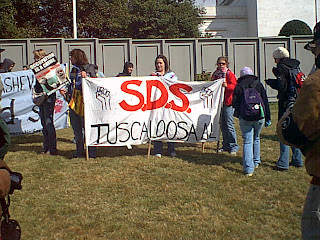
And so four years ago we started marching again, and again,
and again.
"In the Shadow of the War Machine, " Cindy Sheehan said
from the speaker's platform.
But the shadow is not confined to the parking lot beside the
Pentagon, the shadow is cast all over this land, over the
flag-draped coffins as they are unloaded from ships and
planes, over the hospitals where the mangled bodies and
fragmented minds are patched up and shoved on their way,
over the schools and libraries and roads that are deteriorating
because the funds they need for life have been funneled into
death, and over our children who will be paying for the rest
of their lives, and over all those sick and dying from lack of
health care.
Blood on the oil. Our government is run by those with bloody
hands.No more! Support our troops. Bring them all home.
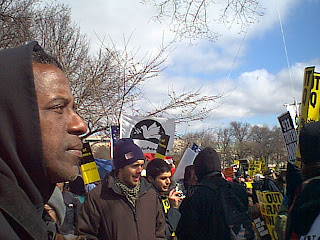
the War in Iraq, 40th anniversary of the 1967 March on
the Pentagon an important landmark in the anti-Vietnam
War Movement. I went on one of the two buses from
Atlanta organized by the Atlanta affiliate of the
International Answer Committee (IAC).

It was cold. A knife-edged wind threatened to whip away
signs as we streamed across the Arlington Memorial Bridge,
thousands of us, heading for the Pentagon parking lot where
some of us huddled against parked vans or the concrete wall
that snaked up the hill, seeking to buffer that ceaseless wind.

Jonquils were blooming in Lady Bird Johnson's garden when
we passed, skirting the cheerful yellow patches, hardly a
blossom trampled. Poor Lady Bird, prattling on and on about
making America beautiful while her husband presided over
napalmed flesh and bomb craters, decidedly unbeautiful
images of mayhem and torture in Vietnam.Until our protests
and marches and raised voices saying No! made LBJ decide
to drop out, made him long to go back to Texas where Lady
Bird could plant flowers and talk about beauty.

And so four years ago we started marching again, and again,
and again.
"In the Shadow of the War Machine, " Cindy Sheehan said
from the speaker's platform.
But the shadow is not confined to the parking lot beside the
Pentagon, the shadow is cast all over this land, over the
flag-draped coffins as they are unloaded from ships and
planes, over the hospitals where the mangled bodies and
fragmented minds are patched up and shoved on their way,
over the schools and libraries and roads that are deteriorating
because the funds they need for life have been funneled into
death, and over our children who will be paying for the rest
of their lives, and over all those sick and dying from lack of
health care.
Blood on the oil. Our government is run by those with bloody
hands.No more! Support our troops. Bring them all home.

Friday, February 23, 2007
Black History, Our History
February Black History Month. The school children have been
learning about educated and talented and brave African Americans
who, despite the barriers of racism and prejudice, shone brightly in
our past. They have been told about W.E.B. DuBois, Harriet Tubman,
Benjamin Banneker, and a host of others.
I wish it had always been so. My memory of the high school history
class is of an endless dull hour when farm boys in overalls stood in the
aisles between the desks, clutching their history books, stumbling
through their assigned reading with long, painful pauses when they
couldn't even guess at the next word.
Columbus discovered America. Washington crossed the Delaware.
Lincoln freed the slaves. White people settled the west, vanquished
the Indians, and made this country great.
Not only Black children, but all children were cheated by not being
taught the complete history of our country and its peoples. Not until I
was in my thirties did I begin to find and read what should have been
made available to me at a much earlier age: the writings of DuBois,
William Still's Underground Railroad, the "colored" troops in the Civil
War, the segregation of troops during WWII, the massacres and
lynchings of Black people.
We were also cheated of the history of workers' struggles for safe
working conditions and a living wage, the successful fight for an eight-
hour day. May Day, the workers' holiday which originated in the U.S.,
not only was not mentioned, but every attempt has been made to
obliterate it.
And, as union was a dirty word in a small Southern town, we were
not only not taught that part of history, we also never learned how,
after they won the right to organize, those who controlled the unions
used them to bar black people from access to jobs in many of the
trades.
However, I was made aware of one African American hero at an early
age. I had heard my mother and my aunt speak of a Dr. Astrapp when
they were reminiscing about the time when my aunt and her children
lived with us in South Pittsburg, Tennessee, during the depression. They
spoke admiringly of the doctor, saying that he was good, meaning by
"good" that he was knowledgeable and competent.
Then, when I was 12 or 13 and my aunt was visiting us in Menlo, she
apparently became angry with my father and, seeking to turn me against
him, drew me aside to tell me that when mother went into labor with me,
my father owed other doctors in the area and they would not come.
"He had to get a colored doctor," she said, "He had to bring in a
colored doctor to deliver you."
That Daddy owed people was old news, never mind the terrible
circumstances of the great depression. He still "drank up" his money
or "lost" it. The depression had never ended for us.
Her efforts to get me to take sides with her backfired. Forever after it
was a part of my own history of myself, the wonder of that doctor who
came when no one else would come, the one whose hands first held me
as I entered the world.
Recently I needed to find my birth certificate, and there was his
signature, Dr. W.J. Astrapp. On an impulse, I decided to search his
name on the internet. One reference, a photo on the South Pittsburg
Historical Society website. Just the photo, scroll down to see it, with
the caption: Doctor W. J. Astrapp worked and treated South
Pittsburg residents and those from outlying communities
for several decades at South Pittsburg, Tennessee. This
well respected African-American doctor .......
What must it have been like for him as a doctor in a small southern
town, population slightly over 4,000 in 1900, but slowly declining since
to 3,295 by the year 2000. Black or white, I'd wager that mine was not
the only family unable to pay. One can be certain he did not become
wealthy from his medical practice. Yet his face shows the character of
one who knows his own self-worth. I learn from the caption under his
photo that he died in 1945, just about the time that my aunt told me
about him.I wrote to the South Pittsburg Historical Society to ask if they
had any other information about him. Carolyn K. Millhiser, Secretary of
the Society, has sent copies of newspaper articles with some information
and referred me to the president of the National African American
learning about educated and talented and brave African Americans
who, despite the barriers of racism and prejudice, shone brightly in
our past. They have been told about W.E.B. DuBois, Harriet Tubman,
Benjamin Banneker, and a host of others.
I wish it had always been so. My memory of the high school history
class is of an endless dull hour when farm boys in overalls stood in the
aisles between the desks, clutching their history books, stumbling
through their assigned reading with long, painful pauses when they
couldn't even guess at the next word.
Columbus discovered America. Washington crossed the Delaware.
Lincoln freed the slaves. White people settled the west, vanquished
the Indians, and made this country great.
Not only Black children, but all children were cheated by not being
taught the complete history of our country and its peoples. Not until I
was in my thirties did I begin to find and read what should have been
made available to me at a much earlier age: the writings of DuBois,
William Still's Underground Railroad, the "colored" troops in the Civil
War, the segregation of troops during WWII, the massacres and
lynchings of Black people.
We were also cheated of the history of workers' struggles for safe
working conditions and a living wage, the successful fight for an eight-
hour day. May Day, the workers' holiday which originated in the U.S.,
not only was not mentioned, but every attempt has been made to
obliterate it.
And, as union was a dirty word in a small Southern town, we were
not only not taught that part of history, we also never learned how,
after they won the right to organize, those who controlled the unions
used them to bar black people from access to jobs in many of the
trades.
However, I was made aware of one African American hero at an early
age. I had heard my mother and my aunt speak of a Dr. Astrapp when
they were reminiscing about the time when my aunt and her children
lived with us in South Pittsburg, Tennessee, during the depression. They
spoke admiringly of the doctor, saying that he was good, meaning by
"good" that he was knowledgeable and competent.
Then, when I was 12 or 13 and my aunt was visiting us in Menlo, she
apparently became angry with my father and, seeking to turn me against
him, drew me aside to tell me that when mother went into labor with me,
my father owed other doctors in the area and they would not come.
"He had to get a colored doctor," she said, "He had to bring in a
colored doctor to deliver you."
That Daddy owed people was old news, never mind the terrible
circumstances of the great depression. He still "drank up" his money
or "lost" it. The depression had never ended for us.
Her efforts to get me to take sides with her backfired. Forever after it
was a part of my own history of myself, the wonder of that doctor who
came when no one else would come, the one whose hands first held me
as I entered the world.
Recently I needed to find my birth certificate, and there was his
signature, Dr. W.J. Astrapp. On an impulse, I decided to search his
name on the internet. One reference, a photo on the South Pittsburg
Historical Society website. Just the photo, scroll down to see it, with
the caption: Doctor W. J. Astrapp worked and treated South
Pittsburg residents and those from outlying communities
for several decades at South Pittsburg, Tennessee. This
well respected African-American doctor .......
What must it have been like for him as a doctor in a small southern
town, population slightly over 4,000 in 1900, but slowly declining since
to 3,295 by the year 2000. Black or white, I'd wager that mine was not
the only family unable to pay. One can be certain he did not become
wealthy from his medical practice. Yet his face shows the character of
one who knows his own self-worth. I learn from the caption under his
photo that he died in 1945, just about the time that my aunt told me
about him.I wrote to the South Pittsburg Historical Society to ask if they
had any other information about him. Carolyn K. Millhiser, Secretary of
the Society, has sent copies of newspaper articles with some information
and referred me to the president of the National African American
Historic Association of Marion County. I will share from these sources
in the future.
in the future.
Subscribe to:
Posts (Atom)