Sunday, September 24, 2006

Drought


48 counties in Alabama and several counties in Georgia were declared natural
disaster areas in June because of the drought. By the end of August, the
Environmental Protection Division had issued a level one drought declaration
for the entire state, and several other southern states were declared in various
stages of drought conditions. Restricted water use, farmers eligible for
emergency loans. Record temperatures and little rain. Farmers and ranchers
in the plains states were talking about the 1930's dust bowl. Now, as then,
stunted corn stalks rattled in the fields, water holes were gone, and large herds
of cattle were sold off to save them from starvation.

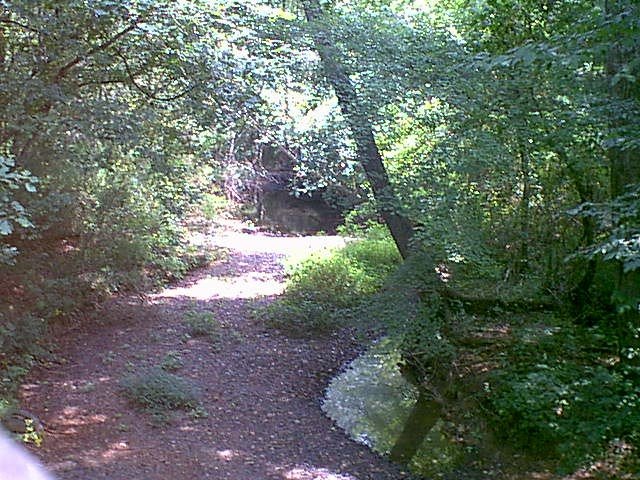
Cane Creek is drying up. The music of running water is stilled. Long stretches
of rock and sand with only an occasional pool of water. It was like this four
years ago, but there were more and larger pools of water then. This is the
worst I've ever seen here. There were a few good rains in August; 24 hours
after the rain ended the ground would be dry, and I would be carrying water
to my little garden and small herb patch.

There is still a stretch of shallow water bordering my yard, but it was divided
into two parts in August, and now in September into three, with rocky barriers
between. One day in August as the water receded, I was in the back yard
when I heard a loud slapping sound. A fish had somehow flipped from the
water onto the dividing rocks. I wouldn't have believed that a fish no larger
than my hand could thrash about so vigorously and make so much noise. I
saved it by flipping it back into the water with a stick. But that fish and many
more will die as the drought continues. They are slowly being deprived of
oxygen, and they normally depend on bugs and debris washed in along with
run off from the rain for some of their food.

Four years ago, as the water sank lower and lower, big suckers over a
foot long lay gasping and dying in the shallows. I've seen no suckers that big
since, and now I'm not seeing even hand-size fish. The shallow stretch of
water along my back yard is covered with an ugly scum.
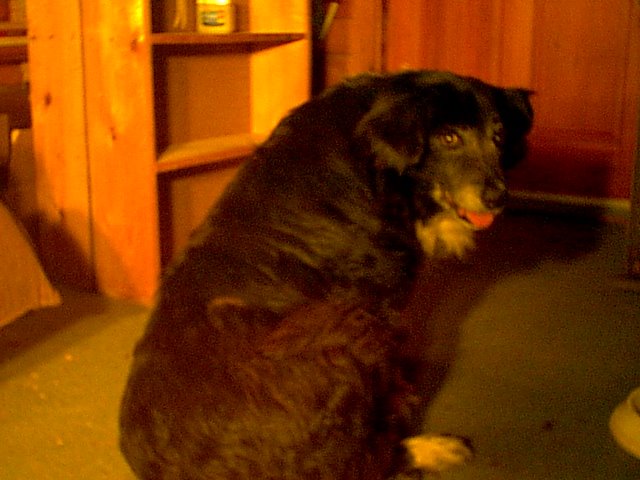
Buckie and I went walking in the dry creek bed, as we did four years ago.
It's the only time we can safely walk long distances through here during the
summer. We can see there are no snakes underfoot on this strange, rough
road.My walking stick was provided by the beavers. There were always
limbs and sticks floating down the creek, each neatly cut at an angle, peeled
clean of bark. I saved those that were straight and sturdy and of a comfortable
length.

The beavers have long been gone. Buckie ran about sniffing their caves.
I wished I'd brought along a flashlight so I could see how far they'd dug into
the creek bank. Only once have I seen the creek ice over, and then the ice
only lasted a couple of days, so they do not need to build winter lodges and
stockpile food as they do in the northern ponds.
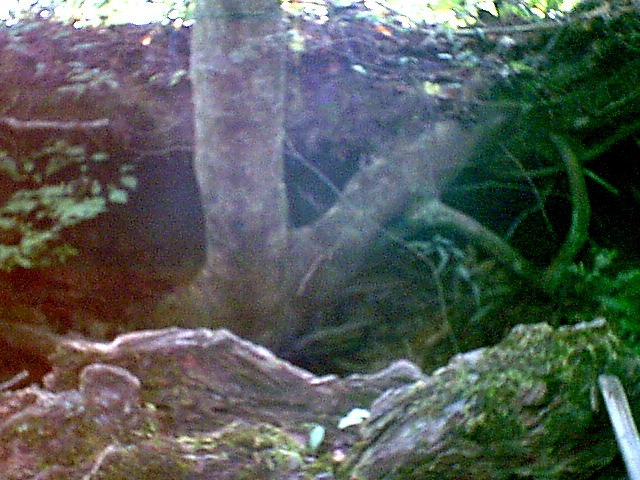


Trees at the creek's edge sent their roots down through the water into the
bottom of the creek bed. Now these roots are exposed, gnarled and twisted.
Behind these roots are the beavers' caves. The odd lacework of roots reminds
me of burglar guards across a storefront. They wouldn't provide the beavers as
much protection as a burglar guard against their enemies, dogs and men, but
perhaps they made them feel more secure.

I wonder where the beavers are, and if they've even survived. I'd think they
would have headed for the nearest water, the Chattooga River, about 7 miles
away. It's still running, though very low. Bevers move clumsily on land.
They would have had to cross highways and fields near houses with dogs.
And the Chattooga River is polluted. The textile factory in the next town
has been fined several times by the EPA for releasing dyes and other wastes
into the river.

In one pool we pass, at least a dozen crayfish dart about. I usually only see
crayfish at night when I stand on the back deck and shine a light into the
water, catching them by surprise before they scuttle backward into the sand.
Also concealed in the sandy bottom in normal times are the mussels. I've
yet to see a live one, but I've often seen their shells, left by some creature
that savours their flesh. Now the empty shells are strewn through the rocks,
many so tiny they seem not worth the effort to open for the tiny morsel within.
Mussels don't seem to grow very large in this creek, the largest shell I've
seen is about 2 1/2-inches long. The shell linings that look like mother-of-pearl
are not as thick and lustrous as in the much larger shells I've taken from the
Tennessee River.

The bits of color in the woods to either side were leaves, gold and bronze
and crimson, turned and fallen two months before their time. Trees were
dying. Dead limbs littered the creek bed.

My attention was drawn to a pile of what looked at first to be rat droppings.
Poking them about with a stick, I discovered they were periwinkle shells, dusty
from dried mud, for they, too, spend much of their time buried, trying to stay
safe from predators. But one must have crouched here, sucking out their flesh
and then tossing the shells into this neat pile.

As to what feasted on the mussels and periwinkles, I can only guess.
Raccoons? Opossums? Or do coyotes roam the woods here, about two miles
north of my house. And I once saw a pair of muskrats swimming down the
creek at night. They were terrified of my light and swam quickly away to
hide. They could also have a taste for shellfish.

Walking down this rocky bed, I've never seen any Indian tools or artifacts.
Most of the rocks are dark and dull, indicating some iron content, or they
are sandstone, not the kind of stone for making arrowheads or tools. And
why should the Cherokees have camped long beside this creek, so
insignificant compared to other bodies of water not so far from here, the
Chickamauga Creek, the Tennessee River, and even the Chattooga River
when it ran clean and pure. And they did not always camp beside creeks
and rivers. I know of fields far from large bodies of water where spring
plowing never failed to turn up a few arrowheads and an occasional stone
tool. At least this was true several years ago.

Even though wading the occasional pool alleviated the heat, it was still too
hot for walking before late afternoon in August, so we could only wander
for about three miles or so up the creek before turning back if we were to
get home before dark.

Another afternoon I had planned to clean the kitchen, but the forecast was
for rain the next day. I thought it could be the first rain of many and the creek
would fill up again. It was four years ago when the creek dried up, and would
it be four years again before I could walk that rocky bed? And would I, when
four years older, be able to walk it?

I set the broom aside and pulled on my creek shoes. The rippled soles help me
to navigate the rocks, and the mesh tops drain out the water after I've waded.

This time we went down the creek, ending up within sight of a house, the first
one visible from the creek during our walks. Children were calling to one
another and someone had started a fire, I suppose for a cookout. The house
was some distance from the creek, but I felt like a trespasser, and we had
traveled our three miles or so.

Shortly before the house there is an underground stream that surfaces just
below the creek bank, filling the creek bed with cold, clear water. It was
only a few inches deep, but felt so good to my feet, cooling and refreshing
me. The evening air was thick with humidity from the impending rain.

Then the dry, rocky stretches all the way home. Here, as up the creek,
I was struck by the silent tragedy of countless deaths. All the tadpoles that
would never become frogs to serenade the summer evenings. There was
never a trace of the fish or the smaller water creatures such as the caddisflies.
The birds and the woods creatures must have feasted.

The polar ice cap is melting and polar bears are losing their homes. Here the
water world had vanished, and how would it affect the surrounding area.

Do not ask for whom the bell tolls..

It was getting dark. We had started out later than usual. Only an occasional
faint star shone through the clouds and there was no moon to light our way.
I was glad when the bridge suddenly loomed a few feet ahead, for under the
bridge and we would be beside our front yard and home.

After walking on sand and rocks, my feet felt as if they had been massaged.
I slept deeply that night and dreamed of running water where fish leaped
silvery in bright sunlight. That dream would be shattered many times in
the following days when I walked the dry creek bed again.

I started writing this in August. By the third week of September, although
we had rain and no longer had the blasting heat that dries up the rain soon
after it falls, the pools of water were noticeably smaller. There was no water
under the bridge. The creek bed had been dry at least a month longer than
it was four years ago. Then at last, during the fourth weekend of September
rain poured down and by Sunday afternoon the creek was filled with muddy,
flowing water. There is again the music of water rippling over rocks and
cascading over the edges of one rocky island that remains. We again have a
creek. The water will become clear in a few days and I will be wading again,
especially after a hot afternoon of yard work or grass cutting. There were
beavers in the creek again after the last drought. I wonder if they or some
of their offspring will come back this time.

Tuesday, September 19, 2006

Tiny But Terrible


The toilet was running and wouldn't stop. I rushed out to turn the water off,
grabbed the railing as I raced down the front steps. And cried out. Felt like
a red hot needle had been jammed into my hand. I went on to the side of the
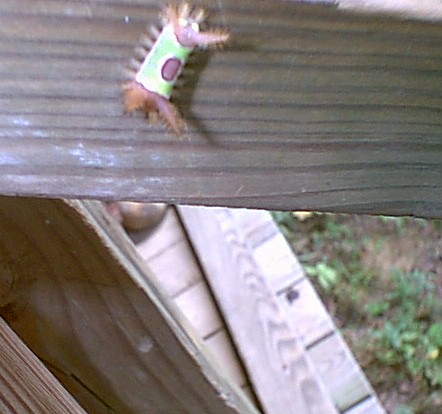
house and turned off the water, Then came back to see what had stung me.

After I took its picture, I rubbed meat tenderizer into my reddened and
swelling palm. It took most of the pain away and helped prevent further
swelling and itching. Then I looked through my Field Guide to the Insects
of America North of Mexico, by Donald J. Borror and Richard E. White,
the Peterson Field Guide Series, 1970, Boston.

Saddleback Caterpillar (Sibine stimulea). All the time I have spent outdoors
and gardening and around trees and I had never seen one, never even heard
of them. One-inch long and its sting is worse than that of a wasp or yellow
jacket. I found more information on several gardening forums. People have
been stung from just brushing against them. I got an especially painful sting
I guess because I pressed it as I grabbed the rail. Some of the spines on its
back are filled with a poisonous venom. All one has to do is touch those
spines to be stung.

Here are some better pictures. Some of the gardeners, like me, had never
heard of the saddleback. One said it looked like a scottie dog. I think of the
pictures of thoroughbreds draped with cloth and the saddle on top of the
cloth. The adult is a drab little moth with dark fuzzy wings and body. The
larvae supposedly feed on tree leaves. This one must have dropped onto
the railing.

What a strange and beautiful creature. If I hadn't been stung, I might not
have noticed it, for I was so preoccupied with the water problem.

Friday, September 15, 2006

Them Bones Them Bones

Them Bones, Them Bones Gonna Rise Again

I just want mine to keep me upright for the remainder of my time above
ground. Judging from the results of recent tests, I think they might. I've just
viewed a chart that shows that bones inevitably "thin" or diminish in density
as one ages. Osteoporosis. Porous bones. Hunched backs and fractured
hips. Caucasian and Asian women are most at risk, as well as men who
have taken steroids.

A Dexa Scan last month shows I've actually increased the Bone Mineral
Density (BMD) in my spine- only by one-tenth-of-one-percent, but I think
any increase is significant.I would have been happy if the numbers had
stayed exactly the same as the first scan showed. But alas, they didn't.
The BMD loss in my left hip increased by -.9. (They didn't have a machine
that scanned both hips in 2004; this time they did.)

Bones change so slowly that Medicare will only pay for a Dexa Scan, also
known as a bone scan, every two years.The two scans I've had show that
I have osteopenia, which means some loss of BMD.

The doctor who ordered the scans prescribed Fosamax, a bisphosphonate,
which has increased bone mass in some people, but not all. After researching
osteopenia, osteoporosis, bisphosphonates, and trying to decipher the Dexa
Scan report, I've decided not to take the medication. I've learned that my
amount of BMD loss increases my risk of fracture by one-percent. Therefore
I don't think the even greater risk of known side-effects of bisphosphonates
is justified.

The University of Washington has an accessible course in bone physiology
which includes a lot of information on understanding the Dexa Scan and
on osteoporosis, including methods of prevention.

Here are my T-scores: Spine: -.9
Left Hip: -1.3
Right Hip: -1.2
My spine is considered "Normal", according to the technician who did the
scan, and according to material available on osteoporosis. T-Scores of +1
to -1 = normal; -1 to -2.5 =osteopenia; -2.5 and higher = osteoporosis.
The yardstick is the BMD of a 30-year-old woman.

So my hips are only -.4 and -.3 points higher in bone loss than my spine,
or those same amounts less than "normal".

Bisphosphonates have been linked to osteonecrosis of the jaw bone,
commonly called "Dead Jaw" and also "Rotting Jaw". A lawsuit was filed
against Merck, maker of Fosamax, in April in Florida. There are other
brand names of biophosphonates: Actonel, Boniva, Zometa, Aredia.
Many of those affected are cancer patients, some having received the
bisphosphonates by IV, and some receiving large doses.

A local pharmacist wrote that "the threat [of 'dead jaw'] is not nearly as
alarming as it might sound. About 94% of the reported cases...occurred
in patients with bone cancer...The incidence is much lower in patients who
take oral bisphosphonates. It's probably less than one case per 100,000
patients per year." And he urges "patients" to continue taking the drug "as
your physician ordered. The benefits probably outweigh the risks."
(Cook's Pharmacy advertisement in The Trion Facts, Wednesday, August
23, 2006)

Unlike Cook's Pharmacy, I find the threat alarming. I would feel more assured
by such a message if it were not from someone who profits from selling the
drug patients are urged to take. And by someone who didn't pepper the
message with the word "probably". I can do my own conjecturing: Probably
Cook's would not so blithely dismiss the risks of osteonecrosis if they or
someone close to them suffered from it.

Attorneys soliciting clients for further lawsuits claim a large percentage of
bisphosphonate-related jaw damage has gone unreported.

I am just as concerned by reports that bisphosphonates can and have caused
visual disturbances, aching joints, and that, if taken for ten years or more, can
actually cause bones to become more brittle and at increased risk of fractures.
But most disturbing of all is that it remains in the body and in the bones for ten
years after one ceases to consume it. Five or six years from now it may be
linked to more, and possibly even worse side effects, and the millions, mostly
women, who will have it in their bodies for years, will be able to do nothing
but wait to see if they will be inflicted with such horrors.

So no thanks, I'm not taking it.
I believe if I work harder at staving off osteoporosis that I can prevent
further BMD loss, or keep it at a very small amount. I believe some of
my BMD loss was caused by my curtailed mobility much of last year
because of sciatica and an injured foot. I stayed active and continued to
work out, but I didn't walk as much and I kept the weights lower on
the leg machines at the gym.

The two main weapons against osteoporosis are taking calcium and weight-
bearing exercise. Walking is a good weight-bearing exercise, but I don't
think it's enough. I'll keep lifting weights at the gym and, thanks to a
chiropractor's help, I'm no longer hampered by sciatica so I have for some
time been using heavier weights on the machines. I don't need to increase my
daily calcium intake, with supplements and dairy products I get enough. I do
need to never get so busy that I forget to take the supplements, so I've made
a note to myself to never skip a day. I also take magnesium. I have read many
articles about how magnesium and calcium need to be in balance, just as do
salt and potassium. Articles on the Magnesium Website show that a high
calcium intake without sufficient magnesium can cause many problems, and
that frequently what appears to be problems caused by a lack of calcium are
actually symptoms of magnesium deficiency.

Another article on the Magnesium Website claims that primitive man, with no
access to dairy products, did not consume a lot of calcium. Our bodies have
changed little since those times, but our diets have changed drastically. The
article implies that it is because of the low-calcium diet in ancient times that
our bodies store calcium. Magnesium, however, was plentiful from whole
grains and green leafy plants. And so, according to the article, primitive man
had a diet much higher in magnesium than in calcium. But we aren't told what
effect this magnesium-calcium balance had on his health, there's just the
implication that this is the natural way to eat. Other good sources of
magnesium are nuts and legumes.

Health care providers routinely tell women to take Tums as a source of
calcium. But reading the fine print on a Tums label shows that 1,000 mg
of calcium carbonate per tablet actually means only about 400 mg of
calcium, and no or very little magnesium.

Some other interesting things I've learned: the diuretic action of coffee
causes some calcium loss from the body. Yet a recent report shows the
value of coffee as an antioxidant and the amount of calcium lost because
of a cup of coffee can be replaced by drinking one-and-a-half tablespoons
of milk. Those who add milk to their coffee are safe.I've always liked mine
black. People who eat a lot of animal protein have denser bones and so do
people who are overweight. Weight loss can cause a loss in bone density.

So one could gobble up the meat, pack on the pounds, and have high
cholesterol and maybe heart disease and strained joints and whatever
other illness baggage that comes with obesity, but have great bones.

I think I'll stick to the plan I've been following, although I will
increase my magnesium intake. It'll be another two years before I have
another bone scan. The results then and any new information I've managed
to gather in the interim may send me back to the drawing board for a
revision.I do know that wellness is not totally a matter of luck: one has to
work at it. We have to learn about our bodies and take charge of our own
health.

At least I have the information that allows me to plan. Thousands of
postmenopausal women in their 40's and 50's without medical insurance or
with inadequate insurance do not. By the time they are able to get the medical
attention they need, many will already have developed osteoporosis and have
no choice but to take the risky bisphosphonates in an attempt to rebuild that
which they have lost. Here in the only industrialized country with no national
health insurance, that hundreds of thousands are broken and debilitated from
untreated illnesses is a national disgrace.

The charge for my last Dexa Scan was $379.00. The imaging facility had to
accept the reduced amount Medicare would pay, but those who do not qualify
for Medicare or who do not have adequate insurance would be responsible for
the full amount, as much as a third or more of the monthly wages of many
women who are already stretching each dollar as far as it will go.

When I went back to the clinic a few days ago for a mammogram I saw a
new sign at the desk. It stated that patients with no insurance must now pay
BEFORE they can see the doctor.

Saturday, September 09, 2006

Giant Panda Baby

Lun Lun, one of the Giant Pandas at the Atlanta Zoo, has a new baby. This
is cause for rejoicing, for Giant Pandas are an endangered species, with only
about 1,600 in the wilds of China, about 200 in captivity worldwide.

The Giant Panda is a symbol of peace in China, and was once used on flags
to signal surrender. It is also the logo of the World Wide Fund for Nature
(also known as the World Wildlife Fund), an organization dedicated to the
conservation and protection of the world's endangered species.

I have mixed feelings about caged animals being displayed, but sometimes
it is necessary for perpetuation of the species. The less than 2,000 in
their native habitat are fragmented, with little communication between those
in separate areas. This means in-breeding and can cause future generations
to be susceptible to physical defects or disease.

The pair at the Atlanta Zoo are on loan-lease from China. Atlanta pays
$1.1 million annually in lease fees, and about another $1.6 million annually
for the maintenance of Lun Lun and her mate, Yang Yang, who were
brought to Atlanta in 1999 on a 10-year loan program.If the cub survives, it
too will belong to China. and will be returned there in 2 to 3 years. If it
survives, it will be only the 5th to be born and raised successfully in
the U.S.

The Atlanta Journal Constitution has provided a video of this unusual
birth. You may have to register to view it, but registration is free and will
enable you to read articles about the pandas. More videos and articles
about cooperation for education and conservation are available on the
Atlanta Zoo website .

Watching this video, one is struck by the wonderful instinct of this animal.
This was her first time to give birth. She was in labor for 35 hours. Lun Lun
weighs 237 pounds, the cub an estimated 4 ounces. (Zoo releases compare
its size to a stick of butter.) It was born September 6, blind and almost
hairless, but immediately after birth it can be heard squealing loudly. Lun Lun
picks it up, holds it gently in her powerful jaws, and retreats to a corner where
she nurses and cuddles it.

She is being watched around the clock by zoo staff who are ready to take the
baby if necessary, but so far Lun Lun has proven to be an excellent mother.
Let us hope the cub continues to thrive.

Monday, August 28, 2006

More Independence

Because July 4th was on Tuesday this year, our family gathered and feasted
on Saturday. Most had to report for work on Monday and wished to rest at
home the following day.

I've had my own special days of Independence in the past, about which I may
write some day, but my July 4th celebration was contingent on burning the
shoulder-high pile of brush accumulated since spring, along with a big trash
can of waste paper from my office.

The county-wide burn ban in effect from May 1st until November 1st provides
exceptions for recreation or for cooking food, so I roasted a couple of hot dogs
and 2 foil-wrapped potatoes and Buckie and I circled the fire a few times, which
might pass for a sort of recreation. Then we waded in the creek to cool off. And
then we ate.

Independence Day is one of the few holidays I can support whole-heartedly.
Even so, I know it does not have the same meaning for all Americans.

I have a CD of Whitney Houston singing America the Beautiful over and over,
5 or 6 renderings of the same song, each slightly different. Quite a trip to play it.
And I like to play it on trips.

From sea to shining sea.

At one point Ms Houston stops singing and calls out: "America- America,
I love you!"

I saw African Americans buying charcoal and all the parts for a cookout on
Tuesday.Yet the Declaration did not mean Independence for their ancestors.

Thousands of slaves and freedmen fought with the British, for the British had
abolished slavery. (Thousands more fought with the Revolutionaries, mostly
Northern Blacks.) And thousands left on British ships for lands where men
could not be bought and sold like cattle. But many were simply abandoned,
left to face the masters they had deserted, when the defeated British pulled out.
And many died from smallpox.

There had been an epidemic, devastating to the Revolutionary Army, but less so
to the British, for more of them had acquired immunity as children. The slaves,
isolated on plantations, were especially susceptible to the disease. Most of those
infected were simply abandoned by the British, or driven into the woods to die.
But some were used in an early example of Biological Warfare: "On July 13,
1781, [British] General Alexander Leslie outlined his plan in a letter to Cornwallis.
'Above 700 Negroes are come down the river in the Small Pox.' he wrote.
'I shall distribute them about the Rebell Plantations'." (Pox Americana, the Great
Smallpox Epidemic of 1775-82, by Elizabeth A. Fenn, New York 2001, p.132
see also p.130)
This seems patterned after the even earlier genocidal plan to give Native
Americans blankets from the deathbeds of smallpox victims.

And purple mountains majesty....

I may not love our history of injustices, but I do love this land. I love the rolling
fields and the deep valleys and even the cities. I love the ridges and hills and
mountains here in North Georgia. My heart lifts up when driving back from the
relatively flat Atlanta area into a higher and higher elevation where the road
begins to wind between wooded hills.
I love this little bit right here beside Cane Creek.

When we first began to march against the war in Vietnam, there were people
on the sidewalks calling out: "Go back to Russia!"

With Paul Robeson I wanted to say: I am an American. I was born here
and here I shall stay.

The biographical book by Robeson, the great African American singer, actor,
former football star, was entitled "Here I Stand.". And so he did. And so shall I.

Saturday, August 26, 2006

Independence Day

Last year July 4th fell on Monday, so when a British customer emailed during
the weekend, urging that the book she was ordering be gotten off first thing
Monday by global priority mail, I wrote her that on Monday the post offices
would be closed and we Americans would gather around charcoal fires in our
yearly ritual of "celebrating our victory over you folks".

"Oh," she wrote, I'd forgotten about your Independence Day," and ended her
message: "But we still love you!"

This year the 4th was on Tuesday. President Bush spoke at Fort Bragg, NC,
home of the 82nd Airborne Division and the XVIII Airborne Corps,
America's only airborne corps and division. "I'm not going to allow the
sacrifice of 2,527 troops who have died in Iraq to be in vain" by pulling out
before the job is done, he said.

According to news reports it was the first time he spoke the actual numbers of
those who have been killed in this futile war. The row upon row of flag-draped
coffins have always been concealed from view. No trumpeting about Gold Star
Mothers.

I think of the young person led to the altar long ago as sacrifice to the tribal god.
If hunger followed, turbulent weather, game scarce, battles lost, did the tribal
members wonder if their offerings were not adequate or not sufficiently
attractive? Did they select two victims for the next sacrifice?

Bush did not speak the numbers of the 10 to 12 thousand wounded, many
maimed for life. He never has.

Does he not believe that their sufferings can be made not in vain by keeping
our troops in Iraq until there are 10 to 12 thousand more mangled bodies
shedding blood upon that ground.

Where have all the flowers gone....

The idea of propitiating the gods does not remain in the distant past. A
chaplain returned from serving in Iraq, in an interview with Terry Gross on
the National Public Radio's Fresh Air program broadcast on July 6th, said he
had counseled a soldier who believed that God was angry with him because he
had not felt remorse over killing an Iraqi and therefore had "visited" his mother
with cancer.

Couple years ago I was in Fayetteville, North Carolina, in the largest anti-war
rally ever held in that city. We, too, wanted to speak to the troops at Fort Bragg,
but that was as close as we could get. We would have told them that we support
them, too. We would support them by not sending them to be wounded and die
in a war that is enriching Halliburton and other big corporations.

Last year I was in D.C. with more than 100,000 marching in the biggest
anti-war action since the end of the Vietnam War. The Bush administration
were not swayed. Polls show that the majority of Americans do not support the
war. Their elected leaders turn a deaf ear, and Bush prattles on about continuing
the bloodshed so that the blood already shed will not have been shed in vain.

I think of the song Pete Seeger wrote and sang during the Vietnam War:

"We're knee deep in the Big Muddy, and the big fool says to push on."

Saturday, August 19, 2006

Pets for a City Backyard


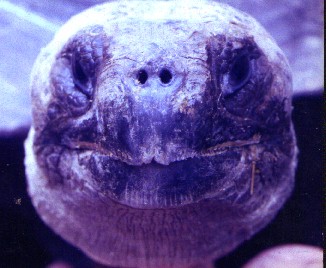
These photos were taken by my daughter four years ago in the Birmingham,
Alabama, back yard of her friends who own these gentle pets.


I was trying to draw its face.


It was easier to take another photo.
That's a bit of dried grass hanging from the side of its mouth.
They go under the house at night and hibernate there during
the cold months.

Monday, August 14, 2006

World's Longest Yard Sale

From Covington, Kentucky, to Gadsden, Alabama, it's called the
World's Longest Yard Sale. Also known as the Highway 127 Corridor sale,
it's usually held the first weekend in August. This year it was August 3- 6.

And every year I talk about taking some time off and traveling as much of the
450 mile, four-state route as I could cover in 4 days. I never did. And this
year I didn't even talk about it. Not in this heat wave.And not with these gas
prices. I just filled my cooler with bottles of water and set out on my usual
daily forays.

On the first day, Thursday, I sped past the parking lots and yards filled with
vendors and the tables set out in front of stores and headed for a place on
Lookout Mountain where I knew there would be books for sale. There I spent
about three hours. There were boxes and boxes of books, some set out
in the blazing sun. It's usually cooler on the mountain, but not a whole lot.
There is usually a breeze, but the sun feels just as hot at that elevation as it
does in the valley.

The books were cheap, but I must have looked poor in my straw hat, for
one of the women in charge came over to me as I sat on the sidewalk,
taking all the books out of one box and slowly putting them back in.
Lowering her voice so the others couldn't hear, she said: "Did you have a
limit to what you wanted to spend? We've added up the books you've set
aside and they come to almost fifty dollars!"

I know I was sweaty and grubby. Or maybe she had heard that old people
sometimes get confused and act erratically.

After I left that sale, I stopped at Mountain Mamas, a complex of little stone
buildings that many years ago were tourist cabins. Now they are filled with
pottery and craft items made by women and jellies and preserves made by
one of the owners. They offer rental spaces out front for the annual yard sale.

I found there a new aluminum squeegee thing for washing the car that had a
longer than usual handle for $1.50. I was standing at a table in the sun which
reminded me my straw hat was missing. I'd left it at the book sale. That hat
was a favorite, so I drove all the way back to get it. And bought another
book. And decided I'd had enough and headed for home, stopping only
to replace the $25 worth of gas I'd used and to buy a gallon of milk.
The sign on the bank read 100 degrees as I passed by at 7 p.m.
I don't know how hot it was in the afternoon.

Buckie always forgives me for leaving him. He's just glad that I have
come home.

It was 77 inside and felt good, but I turned on the ceiling fan because
Buckie likes to lie under it. I've never had air conditioning in this building,
and have never wanted any except for about two weeks in August,
but this year we were already having August weather early in July. Our cold
weather lasted longer than usual this year. I had to keep the heater on much of
the time through early June. And now, with this heat wave that is killing old
folks like me in California, I'm beginning to think seriously about the global
warming theories.

When I went back out on the front porch, I saw a large snake curled in the
shallow water at the far bank. I believed it was a watersnake, but the water
silvered it so I couldn't tell. I tried to photograph it from several positions along
the bank near the house. Too much light reflecting from the water.Then,
because it still lay unmoving, I decided to try and get closer. I put Buckie in the
van so he wouldn't follow me into the creek. And, because this was atypical
behavior for a watersnake, I took along my pistol.

When I got within about five feet of it and was ready to snap a picture, it
glided away. Wish I had snapped the picture sooner. I had gotten close
enough to know it was indeed a watersnake, the dark, heavy-bodied kind
that so many mistake for the poisonous water moccasin or cotton mouth.
This is why so many watersnakes are needlessly killed.

Slaughter of the innocents.

For the next three days I braved the heat and humidity and returned to the
yard sale vendors on the mountain. I got a couple more books, lots of
clothes, a dark pot that I need for making a solar cooker, and a strange
and inaccurate thermometer with little eliptical glass globes that float up and
down. So what if it doesn't tell me the exact temperature, I still like to look
at it. I got it and an ironing board and a slide viewer which also accepts film
strips- exactly what I needed!- on a return trip to Mountain Mamas.

The Tri-County Rescue Service at the Georgia-Alabama state line had
three funeral home tents hung full of clothes, many of them brand new
and most of them really good. They were selling at $1.00 for a plastic
grocery bag full, and, by careful rolling, a lot of clothes could be packed
into one of those little bags. I had to stop there every day because
shoppers were welcome to use the clean john in the firehall. There was
a fireman's boot outside the door for donations.
On the last two days there were signs under the clothing tents urging
people to "Take as many as you can haul off- all Free".
When I went by for my john stop late Sunday afternoon, the tents still
hung full of clothes.

On Friday I had dropped off Buckie for his second shaving of the summer
before heading for the mountain, and at 3 p.m. when I had picked him up
and was driving home, the bank sign read 104 degrees. I'm glad the yard
sale isn't running for two weekends as it did last year.

Buckie after his second and last shaving of the summer


Now I have a van full of books and clothes and not enough closet space
in this building. All my clothes except what I had packed for the trip
and the things I'd bought while away burned with the house. (I most
fortunately had not unloaded the van.) So I had had enough casual clothes,
but not much for dress. Now I do.

And the books- well, I will always find a place for books.

One of the best parts of the weekend was when it rained on Saturday
night. I went out at 11 p.m. with a bucket of suds and the new squeegee
I'd bought and washed the van by the light of the porch light.The blessed
rain, gentle but steady, washed the suds from my van and the sweaty
weariness from me.

Monday, July 31, 2006

Letter From U.S. to Unknown Iraqui Woman

Iraqui death toll rises above 100 per day, U.N. says
- headline in the New York Times 7/19/06


The vines turn clockwise here, but then
I know other places they run counter,
Depending on location of one's garden,
Depending on proximity to the pole.

How are your vines growing,
Do they blossom just the same,
Do your children run barefoot down the rows,
Have you had enough rain?

Oh. Do you have a garden,
A safe place for you to be,
Is there still a bit of earth free
of blood and pain...?

I prepare my garden harvest,
Set heaping bowls and platters on the table,
And call to those I love the best,
We eat and laugh and eat again.

Now as the earth turns to you another day,
I see you bring to your table bread for all,
But oh. Are there any left now,
Any left to call...


Saturday, July 22, 2006

At Home By Cane Creek


This is the best time of the Summer day, when the sun has dropped, a
soft cool breeze stirs, and the birds twitter and chatter, and sometimes a fragment
of song, as if bidding one another good night.

The security light has come on. The globe glows, but will not cast forth light
until it is dark. The bats are gliding in, following the line of the creek, sometimes
swooping down to the water and back, their high-pitched cries cutting across
the last bird sounds.

This strange evening light without the sun softens all the colors, a prelude to
the graying into night.

I've searched without sucess for a picture of the white caterpillar that fell from
the sycamore tree today. It was a fuzzy cream color with fierce-looking feelers
like two horns on its head. My books usually help me to identify the creatures
who live with me and around me.

Sometimes I ask. The long brown feather found in my yard is from a wild turkey,
my son said. Looking at its large, hollow shaft I understand how quill pens were
made. Quite a reservoir for ink there.

I've seen flocks of wild turkeys in the pasture behind this house, and one fall
morning there were a dozen or so in the yard not far from the road. But that was
a year or so ago, and none was as large as the turkeys people raise in pens. The
size and color of the feather prevented my connecting it with the turkeys
traveling through.

The swallow nesting near the edge of the porch roof has stolen back to her
nest, deciding that I'll stay in my rocker for awhile. She pays dearly for the
convenience of her shelter by feeling she has to fly to a nearby tree each time I
come out on the porch, day or night. If the baby birds happen to have their
heads above the nest, they freeze stock still while she coaches from the tree,
until I move away.


The security light glows on the side of the house

This was the second hatching from the same nest, so she didn't even have to
build it. I was watching through the window when the first set of four took their
first flight. They lined up outside the nest while their mother chirruped at them
from the tree.

It was as if she were crying, "Fly! Fly!"
And fly they did, or three of them, that is, albeit somewhat clumsily, one seeming
barely able to make it to the tree only about six feet away, where he fluttered
against the trunk for seconds, then upward a few more inches and onto a branch.
One teetered at the edge of the board, or huddled with back against a brace, all
the while his mother's cries growing shriller, more agitated.

I thought of a parachutist instructor barking out: "Jump! Jump!"
But the bird language might translate more like this: "Fly, you fool! Now!"
His entire three weeks of life had been spent in the safety of the nest,
sheltered by the porch roof, warmed at night beneath his mother's wings,
and now he was being forced to become airborne, with none of the human
baby's chance of trial and error, stumbling and falling, and up to try again,
for he must jump and know at once how to use his untried wings, for his
mother cannot save him if he falls to the danger and even death that may
await him on the ground.

Now the nest is crowded again, although there are only three young ones
this time. The profilgacy of nature. Let there be swallows. Seven new ones,
just in this small spot. There must be an abundance of bugs awaiting hungry
swallows, or else the attrition rate is such that more swallows must be brought
forth just to maintain the swallow ratio among the birds.

I know there are hawks around, and they seem more bold. Only yesterday one
perched in a tree across the creek and sat there watching for at least a
quarter-of-an-hour. And only a few days ago I saw through the kitchen window
a hawk struggling to fly. He would rise a few feet, then sink back to the ground.
It looked as if he were trapped in some fabric-like material caught about his legs.
After watching for several minutes, I thought I must somehow go to his aid.
Perhaps I could grab the material and pull it off of him, or could I throw a net
over him and call a wildlife rescue group?

I thought of ducks getting their feet and bills bound by the plastic six-pack
holders that people toss aside. What careless or deliberate human act had
crippled this wild and beautiful bird.

But as soon as the hawk saw me, he dropped the shredded squirrel and
flew away without his meal.

After recovering from surprise at such rejection and negation of my
misguided impulse to help, I began to hope he'd gotten the squirrel that robs
the bird feeder at the back deck. That squirrel doesn't just eat, he curls
himself around the feeder, and throws out and scatters the seeds he doesn't
want as he searches for the few sunflower seeds.

I know there are people with bigger problems with bird feeders than squirrels,
and here is an example:

Or maybe the hawk got the squirrel that gnawed wider the gap in the enclosed
part of the eaves behind the security light and built a nest in the wall against my
office. I've seen him scratching himself. I fear that my office may soon be infested
with fleas and mites.

Or it may have been the squirrel that ate most of the hickory nuts while they were
still green. Most of those that fell last year had holes gnawed in one side, the
insides hollowed out.

Years ago there were hunters, my father among them, going after squirrels for
food. But now with the deer plentiful again, and still enough quail and wild turkey,
one seldom hears of hunters hunting squirrels and rabbits, and there is an
abundance of them.

Buckie catches and eats an occasional rabbit.
I feel sure that must have been the way he kept himself alive when he was abandoned.

Buckie at the front door last winter wanting out.

But although Buckie and Grace and Buster chased many squirrels, they never caught
one. I don't think most dogs do. The squirrels are too swift for them,
the trees too handy.

It is dark now, and Buckie has begun his evening back and forth with the other
dogs within his hearing distance. It is a nightly ritual that he seems to enjoy. He
stands in his yard and barks and barks, then stops to hear the answering barking,
from the closest house to the faintest sounds somewhere way down the road,
then he's off again.

It is like the primitive tribal communication by tom-tom.
There is no special quality to this evening barking, no urgency nor sounds of
alarm or warning, no threats, just barking to communicate: Here I am. Here in
my yard. And yes, it's reassuring to know that you are there, and you, and all
where each belongs....

It is time for me to go inside now where I belong.
No longer just a building that houses my office, a recreation spot by the creek, this
has been my home since my house burned, and although the pain of loss recurs, I
am somewhat contented.
I, too, for now at least, am where I belong.

Buckie in the creek late in the evening, shaved for the
summer, his hair growing out in patches.